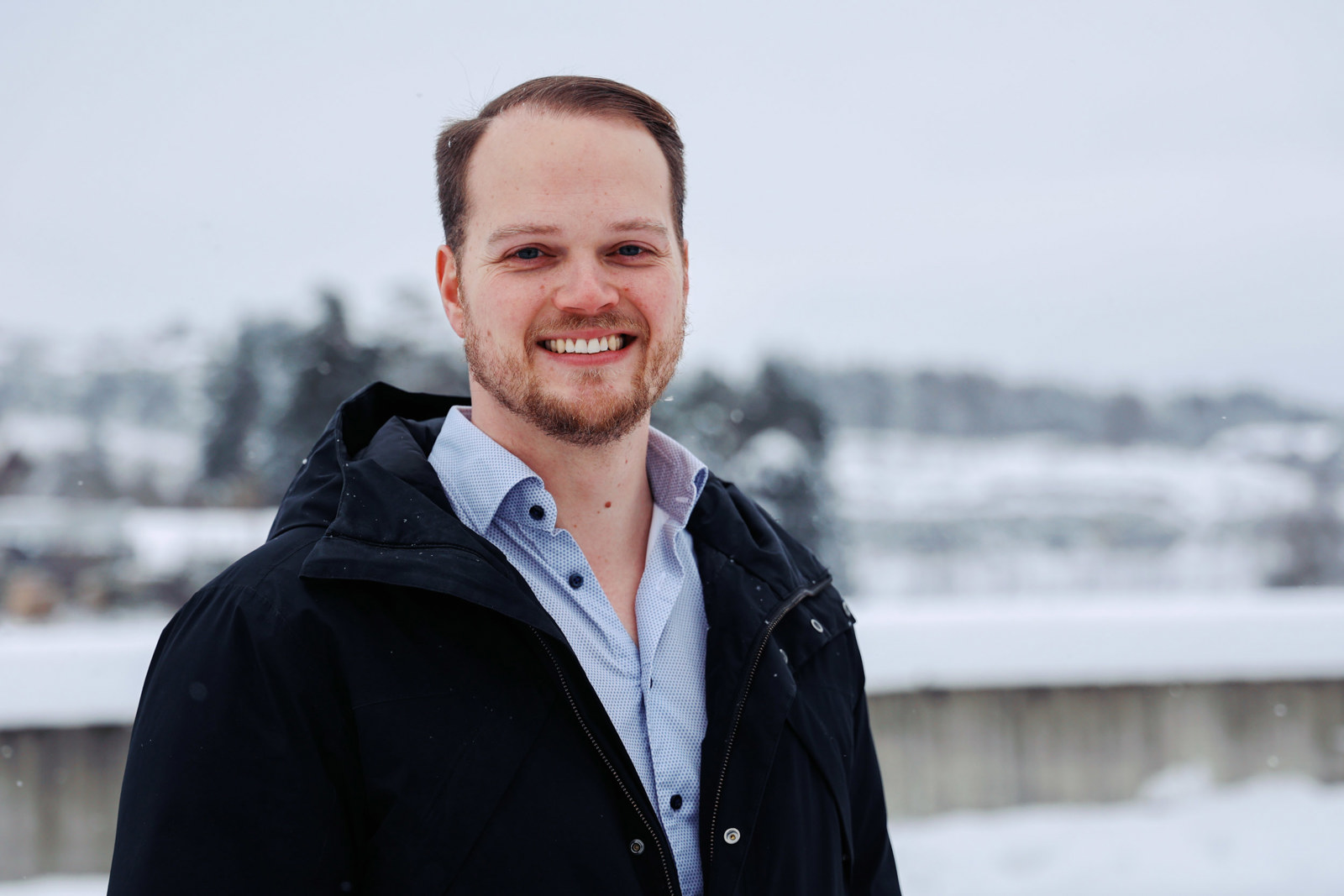
I Like Knowing a Bit About Everything
From electronics and detailed work to the bigger picture and decision-making. In his role as Work Package Manager, Andreas is responsible for the hardware delivery on major air‑defense projects — a senior position that requires technical understanding, oversight, and the ability to make decisions before all the answers are on the table.
-
Text:Helene Bergset
Photo:Helene Bergset / KONGSBERG
“I like knowing a bit about everything,” says Andreas. The transition from a more hands‑on technical role to becoming a Work Package Manager has given him an entirely new perspective on his working day.
Previously, his days were filled with cables, signals, and specific electronics tasks. Now, his job is more focused on design choices, leadership, and prioritization.
“In short, a Work Package Manager is a sub‑project manager. Instead of working in the details, I have an overall view of the bigger picture. That suits me very well,” he explains.
Broad Responsibility
A key part of the role is mapping out and planning the hardware delivery in projects.
“I assess how many hours tasks will take and estimate the development costs our subcontractors are likely to have. Recently, I’ve also contributed to the sales department in connection with contract add‑ons, where I define what we will actually deliver to ensure the right pricing,” he says.
He emphasizes that the role requires both technical depth and the ability to step back and see the bigger picture — and it is this combination that makes the job both challenging and interesting.
Shaped by Experience
“I’ve received solid internal training,” he explains.
After 11 years with the company, he has developed internally and taken on many different tasks.

Not everything has been a perfect match, but all the experiences have been valuable to bring forward. One of the things I appreciate most is that you’re given room to grow, explore new areas, and find out what you truly enjoy working with.
The experience Andreas has built over the years gives him invaluable professional weight in his current role.
“My role is actually threefold,” he says. “I follow up on people and the technical work, I’m responsible for reporting and project management, and in addition, I have an SME (Subject Matter Expert) role where I use my technical expertise.”
“That means answering questions and making decisions at a higher level — both upward and downward in the project organization — and assessing what is actually feasible in project execution,” he elaborates.
Right now, the team is working in parallel on two projects in different phases.
“One is in the final phase, where we are testing the system and ensuring that components communicate as planned. The other is in the middle of the development process, where we are, among other things, planning the procurement of components so production can begin,” he says.
When Not All the Answers Are Available
“Things often move quickly and simultaneously — and that’s exactly what makes the job both challenging and exciting,” says Andreas.
Time margins are not always generous, and decisions often need to be made before all the facts are clarified.
Often we have to decide when we’re only about 80 percent certain. For progress, it’s important that we are willing to make decisions — and that’s where experience plays a major role.
Much of the work involves probability assessments and experience‑based choices.
“We build on what we know works and adjust when we learn something new,” he says.
To ensure a shared understanding within the project, the work is continuously documented.
“We document as we go, both to help new team members and to ensure good internal communication, so everyone always knows where we are in the process. In addition, we use a self‑developed hardware guideline with technical and mechanical solutions we know work. It’s a living tool that both new hires and experienced employees actively use,” he explains.
Low Threshold and an Open Door
The working environment is described as open and inclusive.
“Unless someone is in a Teams meeting, the door is almost always open. There’s a low threshold for both informal conversations and professional discussions, and you always get advice and support when you need it,” he says.
The Senior Role in the Team
As an experienced Work Package Manager, Andreas also plays an important role in developing the team.
“Seniors have a responsibility to guide and be good role models for young and newly graduated employees,” he says.
At the same time, he emphasizes that training is a shared responsibility.
“Those who are often best at training new hires are those who have been here for one to two years. They’ve recently gone through the process themselves. That allows them to gain leadership experience early, while more experienced employees provide guidance on the larger and more complex issues,” he explains.
Never Fully Learned
What makes people choose to stay at KONGSBERG for a long time?
“I think it’s largely about the culture. We have a social and positive environment, but also a way of handling mistakes that creates psychological safety. When problems arise, the focus is always: ‘How do we solve this?’ — not who is to blame,” he says.
“We have a saying: ‘Only those who do nothing make no mistakes.’ That makes it easier to dare to try new things,” he continues.
“Even as a senior, you’re never fully learned. There’s room both for those who want to deepen their expertise and for those who want to try new things. There’s space for everyone here,” he concludes.