Next-gen UT vessels strike Olympic gold
Efficiency, sustainability and innovation are at the heart of Kongsberg Maritime’s latest subsea construction vessels – a project steered by hugely successful collaboration.
-
Craig TaylorSenior Manager PR & Communications

Stig Ole Borgundvåg, Chief Designer – Subsea.
@Cecilie Hatløy_Møre Media
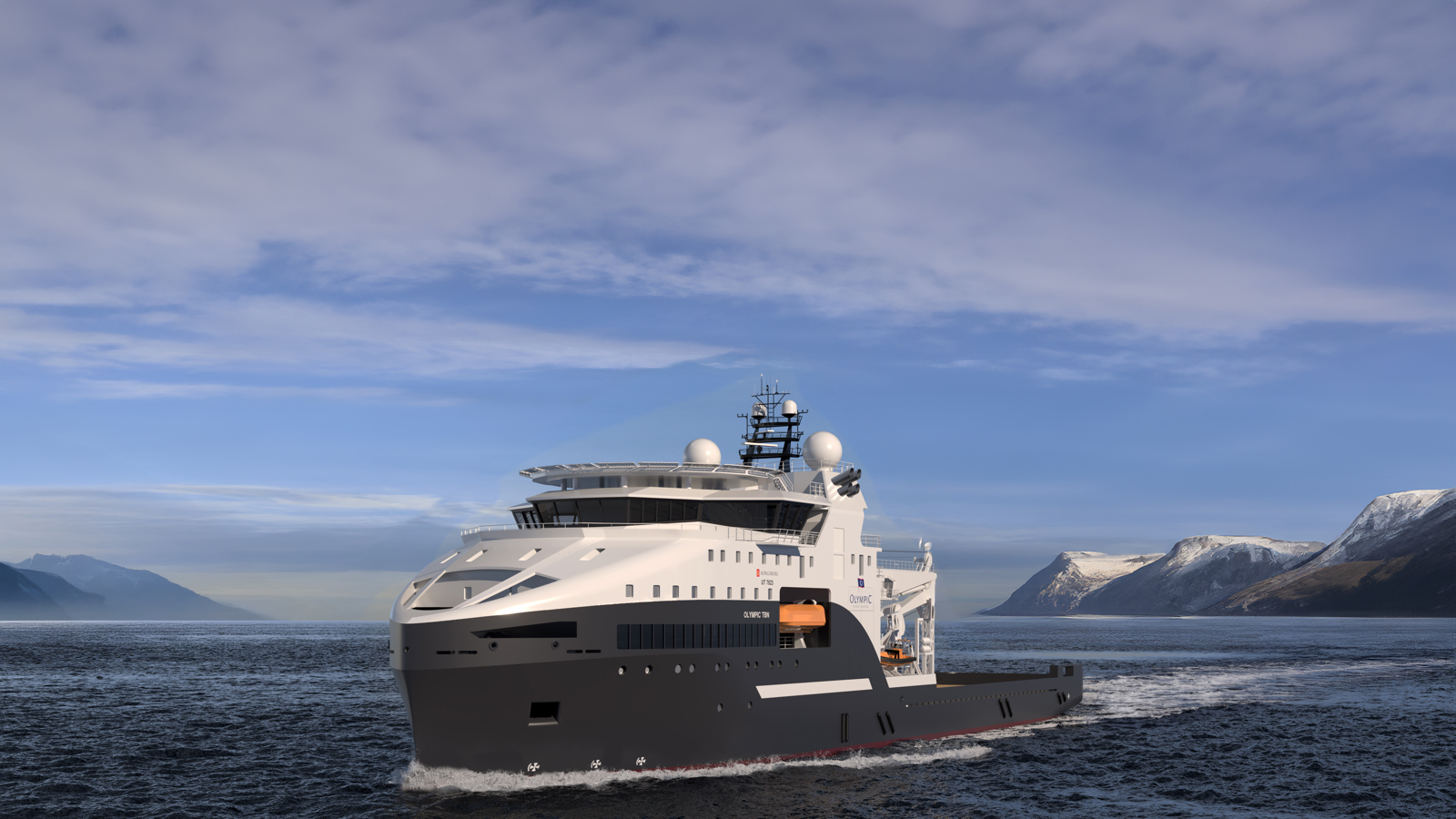
Working towards a more efficient and low-emission offshore future is vital, says Runar Stave, Chief Technical Officer, Olympic, with this UT 7623 design offering smarter, more sustainable and future-facing operations

(Runar Stave, Chief Technical Officer, Olympic).
The strength of the UT 7623 lies not in any single technology but in how the different systems work seamlessly together. The combination of variable-speed generators, advanced energy storage and an integrated power management system allows the vessel to operate in an exceptionally wide range of modes while always staying close to the optimal point for fuel efficiency.
Hybrid propulsion gives us the flexibility to balance battery power and diesel power dynamically, depending on the operational situation. This means we can maintain DP-class performance with fewer engines online, reduce unnecessary running hours and ensure that the engines we do use operate under ideal load conditions.
It’s this holistic approach, not one component alone, that delivers the major step-change in consumption and emissions performance.
The vessel’s smart energy management system continuously analyses the power demand of every operation and selects the most efficient and environmentally friendly way to supply it.
By coordinating all available power sources, the system ensures no energy is wasted and that we always operate in the most efficient mode possible. This supports Olympic’s emissions-reduction objectives, by reducing fuel burn and unnecessary equipment usage across the vessel’s life cycle.
Based on our analysis and benchmarking, we expect the UT 7623 design to deliver fuel and CO₂ reductions in the range of 30 to 65 per cent compared with comparable vessels currently sailing. In certain operational modes, we also anticipate significant reductions in maintenance requirements, thanks to fewer running hours, better load control and smarter system integration. Over the vessel’s lifetime, this translates into substantial cost savings as well as a far lower environmental footprint.
Sustainability has been a core focus for Olympic for many years, long before it became industry standard. Our ESG programme is now a structured, measurable framework that guides decisions across the organisation, and the UT 7623 fits directly into this long-term direction.
We are proud that this work has been recognised externally, including being shortlisted for the OSJ Environmental Award 2026. The jury highlighted our structured ESG work, our commitment to ethics and safety, our climate transition efforts and our ambition for net zero by 2050. These new vessels are a major step on that journey and a natural continuation of the culture we have built over decades.
Our collaboration with Kongsberg Maritime has been both inspiring and highly productive. Many of their engineers know Olympic’s operational philosophy well – we’ve worked with several of them for decades – and that creates a unique foundation for innovation. Their hydrodynamic and design teams have challenged every part of the vessel’s interaction with the ocean, from hull form and appendages to propeller design and energy optimisation. Their willingness to ‘leave no stone unturned’ has been crucial in shaping a vessel that truly pushes the industry forward.
“Our collaboration with Kongsberg Maritime has been both inspiring and productive... their willingness to ‘leave no stone unturned’ has been crucial”
Olympic was the first to test rim-drive thrusters in full-scale commercial offshore operations and that experience has given us a solid technical basis for choosing the technology again. We know how it performs in demanding offshore work, both in terms of efficiency and precise manoeuvring.
For the UT 7623, rim-drive is a logical continuation of that proven approach. The response characteristics, low noise levels and reduced mechanical complexity fit well with the advanced driveline and DP philosophy, as well as supporting the high level of operational control for which these ships are designed.
For subsea operations, safety and predictability are everything. On the UT 7623, we have heavily focused on creating a clean, obstacle-free hangar to improve both operational flow and safety during ROV handling.