Decarbonisation

A force of nature

By harnessing wind energy, Kongsberg Maritime’s K-Sail solution is delivering greener, more sustainable shipping options. Trials have been positive and the future is bright and breezy. 

  • Craig Taylor
    Senior Manager PR & Communications

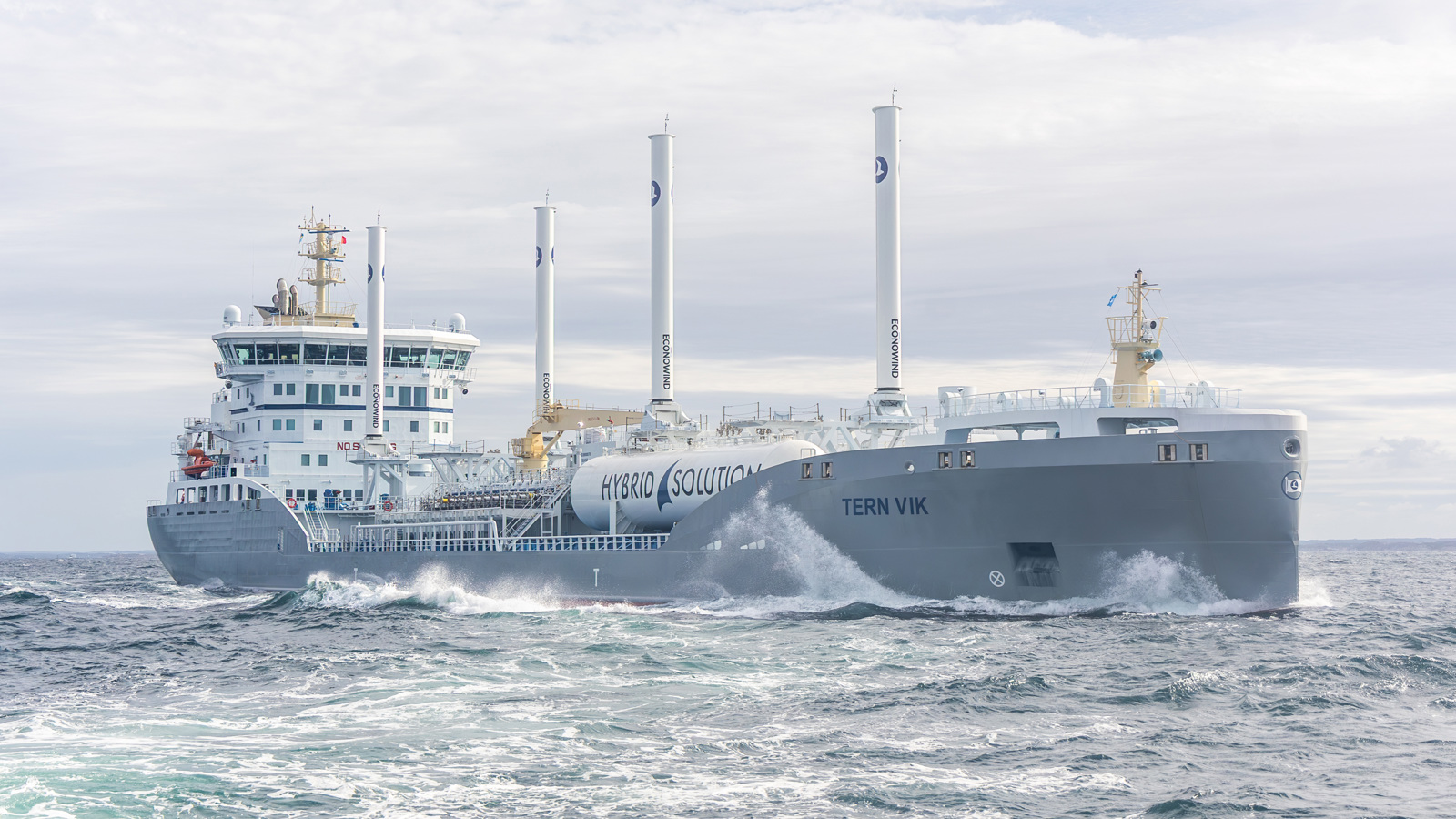
When Tern Vik entered service in late summer 2025, it marked a milestone for Kongsberg Maritime’s K-Sail solution and for Terntank’s sustainability ambitions.  
The chemical tanker, the first of five on order from owner Terntank, is equipped with four suction sails from Econowind and integrated with Kongsberg Maritime’s digital optimisation systems. It has been quietly proving that wind-assist technology can deliver real-world benefits.  After its debut as the star attraction at Donsö Shipping Meet, Tern Vik transitioned seamlessly into commercial operation. 

“This is a pilot installation,” explains Henrik Alpo Sjöblom, Kongsberg Maritime’s K-Sail Technical Lead.

“We’re developing K-Sail into a solid wind-assist solution by learning from real-world data. Our approach is deliberate. We analyse the vessel, advise on the appropriate sail technology, integrate our systems and then refine performance through continuous harvesting of data.”

“Aerodynamics around a vessel with sails is complex,” Henrik adds. “The only way to get accurate insight is to collect data during operation and refine the wind model as we go.” 

Working with the Research Institute of Sweden (RISE), Kongsberg Maritime supported a structured sea trial programme last autumn to validate sail performance against theoretical models. And the verdict so far? “Positive,” says Henrik. “The sails are performing slightly better than we expected. Some more testing is needed before the final verdict, but that is what a pilot programmeis all about.” 

“The system is simple – on/off, up/down – and the sails do the rest,” Henrik explains. “That low threshold for use means that, so far, the sails are deployed whenever possible, with some exceptions when navigating in and around ports, for visibility.” 

Tern Vik’s wind-assist technology is leading the way in sustainable shipping  
Beyond the sails, K-Sail’s strength lies in integration. The ship itself is of Kongsberg Maritime design – NVC 615 CT – and the K-Sail system works alongside an equipment package which includes K-Chief automation and propulsion control, controllable pitch propellers (CPP) and AutoChief. “We adjusted the combinator curve to match sail performance,” Henrik says. “When wind conditions are strong, the system can optimise propeller pitch automatically.” 

Currently, engine speed adjustments onboard are manual, based on advisory input from K-Sail. The next step is to move to semi-automation. This would mean an ‘execute’ button for crew, and eventually full automation. “We need confidence in the system before removing the human from the loop,” Henrik explains. “But optimisation is already happening.” 


Focus on fuel 

Fuel savings are evident, thanks to reduced engine load when sails are deployed. While exact figures are still being compiled, Henrik confirms performance is tracking ahead of expectations.  

“When it comes to fuel savings, we can see that we meet the expectations based on the theoretical calculations made before installation. There is also a possibility that the savings will increase over time.” 

He continues: “Our crews have received training to understand how wing sails work, including their aerodynamic principles, control systems and integration with navigation. Charterers are attracted by the potential for reductions in fuel consumption, so it is important for us to demonstrate the benefits with hard data.  
“We must prove that wind-assist isn’t just a nice idea, it’s a practical solution for reducing fuel consumption. With five of eleven vessels equipped, we will have a critical mass to gather operational data across different routes and conditions.  
Claes adds: “These ships will serve as testbeds, allowing us to compare fuel savings, emissions reductions and maintenance costs against our other vessels. Based on proven savings and operational reliability, we can decide whether retrofitting older vessels is economically viable.” 

Fuel savings are a primary benefit of the new vessels 
Digital voyage optimisation

The next step for K-Sail is the addition of its Voyage functionality, a digital tool that goes beyond route planning to optimise entire voyages. “It’s about using weather forecasts and adjusting speed and power dynamically,” Henrik explains. “If strong winds are coming, you can  slow down now and take full advantage later. The goal is to match the ETA in port, not just maintain speed.”  This capability, combined with wind-assist and hybrid propulsion, promises significant savings, both in fuel and emissions.