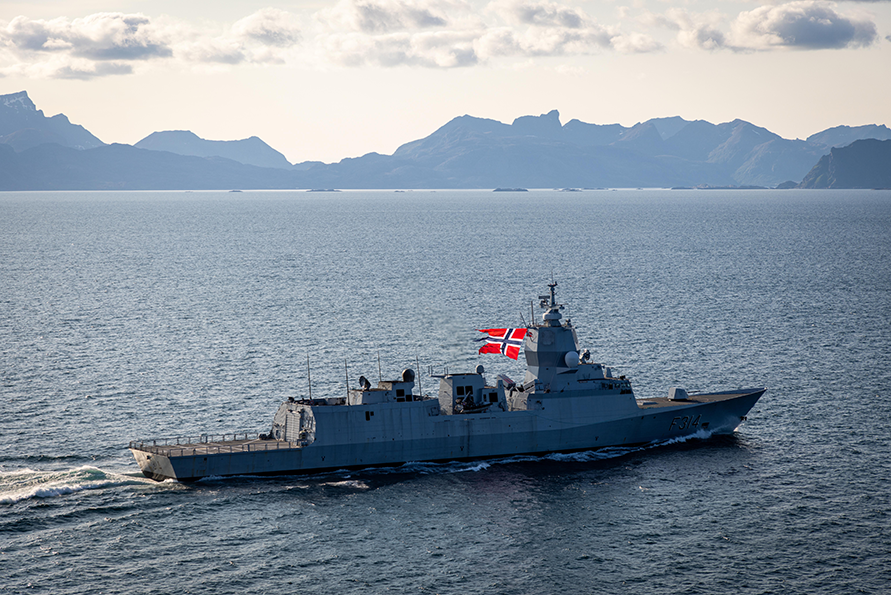
One of the Norwegian Navy's frigates out sailing.
Environment

Green horizons: Norway’s naval future anchored in sustainability

Kongsberg Maritime is helping the Royal Norwegian Navy achieve its decarbonisation goals with advanced integration, energy-efficient design, and flexible fuel strategies.

  • Craig Taylor
    Senior Manager PR & Communications

As climate change reshapes global security, NATO has declared environmental sustainability a strategic priority. Norway is responding with a bold naval renewal programme, including a new fleet of standardised vessels for its Navy and Coast Guard (Kystvakten). Central to this effort is a pilot study on sustainable solutions, initiated and led by the Norwegian Defence Materiel Agency (NDMA), with Kongsberg Maritime playing a key role.

Climate and security: A strategic imperative

“Climate change matters for our security, therefore, it matters for NATO,”

said NATO’s former Secretary General, Jens Stoltenberg, in 2023. This principle underpins Norway’s climate and environmental strategy for its armed forces and is reflected in the long-term defence plan, spanning 2025-2036, which includes a NOK 600 billion increase in defence spending.

A major component is the Fleet Plan 2024, which outlines the acquisition of five new frigates, six submarines and up to 28 ‘standardised vessels’. Without intervention, emissions from this expanded fleet would rise sharply, contradicting Norway’s environmental goals.

Contribution to the pilot study

Kongsberg Maritime contributed to two of six workstreams in the NDMA’s pilot study, with Pål Andersen (pictured), of Kongsberg Maritime’s Naval Systems business unit, leading one focused on sustainable vessel design. Supported by the Integration & Energy Solution Design team, the study brought together 40 participants from 20 organisations, including defence agencies, research institutes and private companies.

“This has been a great opportunity to align with the Norwegian Navy and demonstrate our commitment to decarbonisation,” says Jarle Solvang, Kongsberg Maritime’s VP Naval Business Development.

Designing for efficiency and flexibility

The pilot study focused on three phases: design, construction and operation. In the design phase, two priorities emerged:


•    Energy efficiency:
Modern electric propulsion and energy-saving measures could reduce vessel emissions by 20 to 25 per cent.

•    Fuel flexibility:
With uncertainty around future fuel availability and cost of emissions, vessels must accommodate multiple fuel types. Furthermore, vessel operators should prepare for future modifications as it is likely that the vessels will have to be modified during their operational lifespan.

“The study looked at 20 different fuels,” Pål explains. “There’s currently no ideal single solution, so flexibility is key.”

To support alternative fuels, such as methanol or LNG, the study investigated lengthening the standardised vessel design by around 10 metres, creating space for systems for the additional fuel and fuel storage.

A dual-fuel strategy

The proposed solution is a dual-fuel capable system: marine gas oil (diesel) for high-intensity operations and alternative fuels for peacetime. “In peacetime, you can run on methanol or LNG [or other e-fuels]. If conflict escalates, you switch to diesel,” Pål says. Batteries are also part of the mix, particularly for low-speed or silent operations.

The study highlighted the differing operational profiles of navy and coastguard vessels. “Coastguard vessels operate at high intensity. That could be up to 320 days at sea per year,” Pål notes. “Navy vessels are typically less active in peacetime but ramp up during conflict.”
This insight supports a flexible fleet concept: coastguard vessels that can be reconfigured for naval use as conflict escalates. “It’s about maximising utility and reducing idle capacity,” Pål adds.

Construction and life cycle emissions

The construction phase is another area of focus. “Using green steel can significantly reduce emissions,” Pål says. Operationally, smarter sailing patterns and the use of unmanned systems (USVs, UUVs and AUVs) are key to reducing emissions and improving efficiency.

Pål Andersen, Kongsberg Maritime Naval Systems

Doing nothing will likely be very expensive. Sustainable solutions are not just environmentally sound; it is very likely that they’re financially smart.

Pål Andersen, Kongsberg Maritime Naval Systems

Kongsberg Maritime’s approach centres on adapting proven commercial technologies for naval use. “We want to bring commercial products into the naval domain with as little modification as necessary,” Pål says. “With 30,000 commercial vessel deliveries and growing naval experience, we are well-positioned to bridge the gap.”

This also helps address crewing challenges, as commercial solutions have a higher degree of automation and facilitate reduced crewing. “Navies struggle to find personnel,” Pål  notes. “Using commercial systems makes it easier to train and recruit.”

Digital and autonomous solutions

Kongsberg Maritime is introducing integrated platform management systems (IPMS), bridge and navigation systems and intelligent energy management systems (IEMS) into naval platforms. “These systems reduce emissions and improve efficiency,” Pål says.

Autonomous systems also play a role. “Using drones and USVs can significantly reduce emissions,” he explains. “It’s the same logic as in the commercial world – replace large, crewed vessels with smaller, uncrewed ones when possible.”

A national commitment to greener defence

The pilot study is part of the Norwegian Green Shipping Programme and aligns with the Norwegian Defence Pledge. The findings were presented at Nor-Shipping 2025 by NDMA leadership, with Pål showcasing Kongsberg’s green naval solutions. This included the Vanguard concept, a system-of-systems approach integrating USVs, UUVs, AUVs and digital infrastructure.

“Vanguard isn’t just a ship, it’s a systems-of-systems concept,” Pål concludes. “And it’s one that’s built for the future.”