Handling solutions

Innovation packed with the flex factor

Despite a drop in recruitment rates, the role of naval vessels is expanding, especially amid the rising use of drones. Kongsberg Maritime’s new Mission Bay Handling System is helping tackle the resulting onboard logistical challenges through inventive solutions. 

  • Craig Taylor
    Senior Manager PR & Communications

Despite a drop in recruitment rates, the role of naval vessels is expanding, especially amid the rising use of drones. Kongsberg Maritime’s new Mission Bay Handling System is helping tackle the resulting onboard logistical challenges through inventive solutions. 

The demand for all manner of surface and subsurface drones is growing rapidly and navies are adapting by repurposing surface vessels into ‘mother ships’ capable of rapidly deploying, controlling and retrieving them. Achieving this kind of flexibility, quickly and affordably, is one of the key challenges facing naval operators today. 

Kongsberg Maritime is making this task easier, cheaper and more reliable thanks to upgrades to our Mission Bay Handling System (MBHS). “Each vessel has several missions nowadays,” says Robert Breivik, the company’s Senior Sales Manager, Naval Handling Systems. “Before, it was more specific – one vessel did one mission. Now we see more multi-purpose vessels coming out, and they must be flexible,” he says.

“That’s where our system comes in. There should be no reason for a vessel to go into the yard for a refit or rebuild for another mission. With our system, this can all be done with a stop at the quayside,” says Robert. Vessels can therefore change missions, even while under way. 

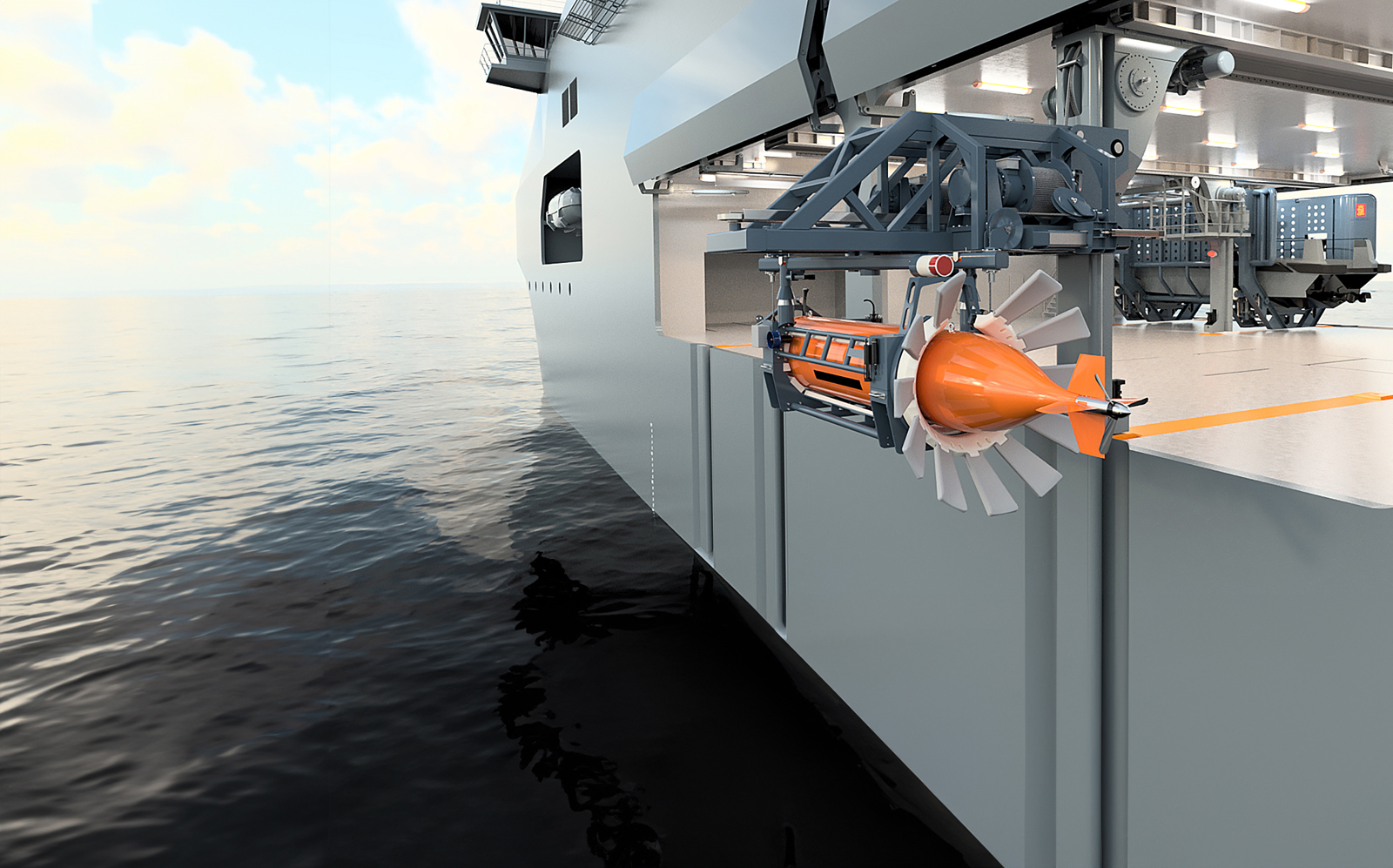
Such innovations are driven in part by the need to adapt to the new era of drone warfare and to reduce downtime, cost and manpower requirements. Kongsberg Maritime engineers have developed an advanced launch and recovery system (LARS), which allows subsurface launch and docking of autonomous underwater vehicles (AUVs) at depths down to 90 metres. The approach integrates advanced sensor technology with handling expertise in heave compensation and automation. This widens the weather window for AUV operations and improves safety for both the mother ship and AUV.  

A key challenge for naval planners is that the pace of change in naval drone technology is faster than that of traditional surface vessel design. Breivik notes that the smaller size of unmanned surface vehicles (USVs) and faster development time for drones means that existing ships and even new-build vessels need to be future-proofed for advances in drone technology.  
 

Kongsberg Maritime has therefore developed a multipurpose crane with a gripping tool that can be quickly changed to handle containers, new drones or manned craft. A single operator can remotely use the crane. The MBHS is also designed to allow updates that do not require extensive refits to the system, thus enabling launch, recovery and handling of new in-sea assets. 

Kongsberg engineers have also created a containerised system for AUVs, to make this system even faster and more flexible. It allows for more unmanned vessels to be stored onboard. Another upgrade is a flush-deck system for handling containers and cargo, which reduces hazard risks faced by the crew. The focus on modular solutions provides flexibility for naval vessels, allowing operators to select sub-assemblies to create their own handling solutions.  

Commercial solutions to naval challenges

Increasingly, navies are looking at commercial technology to find solutions to pressing problems. Securing seabed assets such as power cables, information systems and pipelines has rapidly become an urgent priority.  
Yet the time it takes to design and deploy a specific vessel for such tasks is measured in years, if not decades. Naval planners have therefore started looking at the commercial world for solutions.  

Robert points to a case in which the UK’s Royal Navy acquired two platform supply vessels from the offshore energy industry and converted them, in a matter of months, into vessels that could provide security and protection of the UK’s seabed assets.

Kongsberg Maritime’s MBHS can be fitted into commercial vessels as part of a similar refit and deployment programme. Robert reports that, in some cases, navies are dropping various military requirements for auxiliary vessels to help speed up deployment.  


“The products we have developed for the naval business have been proven in the commercial offshore energy sector for many, many years,” says Robert, who started his career 30 years ago developing LARS systems for offshore vessels. “The oil companies have been monitoring their gas lines on the seabed for many years and that is exactly what the navies want now,” he adds. 
 

Security in small packages 


Another key development from Kongsberg Maritime engineers since 2023 is the creation of a smaller version of the MBHS, suited to offshore patrol vessels. 
Engineers used a telescopic beam device to reduce the footprint and deck height required for a MBHS to just two metres. The smaller system retains much of the flexibility in operation as the crane-based system. The beam-based system can deploy to starboard or port, pick up containers or launch vessels, and can tilt and telescope.  

“The system is optimised for smaller vessels but we have the same goal as with the larger MBHS and that is to be able to handle more assets and increase flexibility,” says Robert. 

As navies are faced with a rapidly changing environment, Kongsberg Maritime’s Mission Bay Handling System is being refined to meet those needs with lean crew solutions and flexibility in operations.