60 Years of Azimuth Thruster Innovation: How Kongsberg Maritime Transformed Vessel Propulsion
For six decades, Kongsberg Maritime has advanced azimuth thruster technology—transforming vessel manoeuvrability, efficiency, and sustainability. From pioneering designs in the 1960s to today’s high-performance solutions for offshore, ice-class, and cruise applications, innovation continues to drive progress.
-
Text:Global Marketing and Communication
Photo:@Kongsberg Maritime
Few innovations have reshaped marine propulsion like the azimuth thruster a steerable propeller system that rotates 360 degrees for unmatched manoeuvrability. First introduced in 1965 at our Rauma facility, these thrusters began with just 60 kW of power. Today, they deliver megawatt-scale performance for vessels operating in the harshest environments. This evolution reflects decades of engineering expertise, enabling safer operations, improved fuel efficiency, and new possibilities for sustainable shipping.
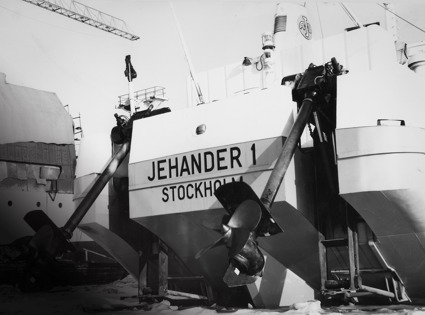
Yet, the technology was largely ignored for most of its design and development history. Patents on concepts and designs for an azimuth thruster were issued in the United States and the United Kingdom throughout the 19th century. Engineers only started to develop the technology in the 1950s. The first azimuth thrusters from Finland, built at what is now Kongsberg Maritime’s Rauma facility, debuted in 1965. The power rating was just 50 horsepower (37 kW). By 1975, azimuth thrusters were available in power ratings from 100 to 800 hp, but overall production volumes were small, and the technology was not considered appropriate for large vessels.
Developments aiming for efficiency or improved bollard pull continued and new models were launched. The Contaz thruster, which used contra-rotating propellers to recover swirl energy for more thrust, was introduced in the 1990s.

The technology around azimuth thrusters has developed since the early years.

How offshore stopped worrying and learned to love azimuth
Yet, the widespread view among builders and owners at the time was that “proper”, ocean-capable vessels needed propeller-and-shaftline systems, according to Juha-Pekka Vesa, Kongsberg Maritime’s Manager – Products, Thruster Systems. Ships equipped with azimuthing thrusters as their main propulsion were simply not considered “real ships”.
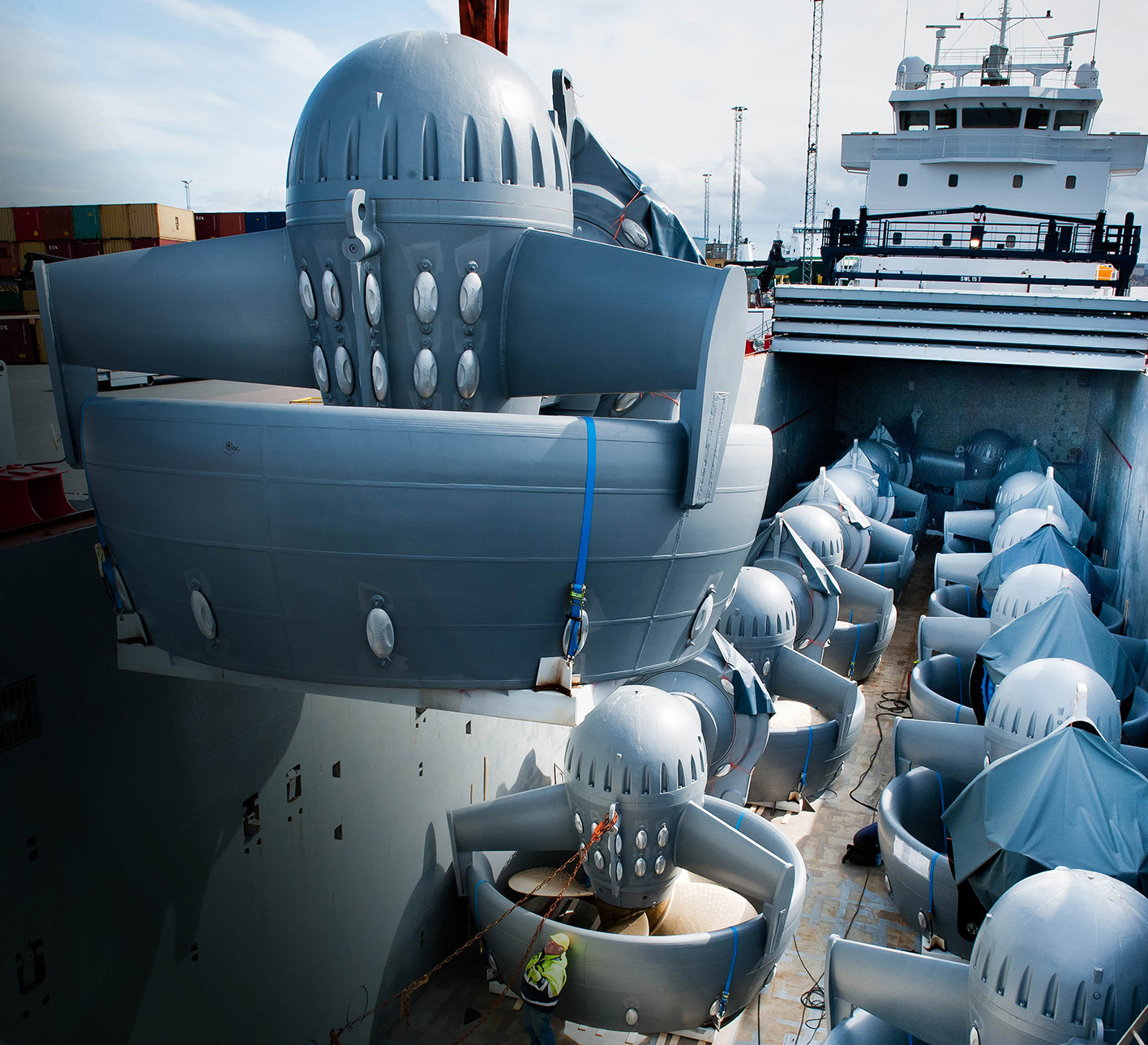
The big break came in the early 1990s with an order for azimuth thrusters for two 116-metre Finnish icebreakers. Each thruster weighed 240 tonnes – a massive step up in size and capacity from previous models. “It really was the proof that a very large azimuth thruster could be built and that we could actually make a thruster that can cope with harsh conditions and be reliable,” says Juha-Pekka. These new ARC thrusters were game changers in the common perception of what azimuth thrusters could do. “That really proved that we could make some really heavy stuff for really heavy duty. I would say that once we had that reference, it worked as a spin-off for the big boom we had on the UUC [Underwater Unit Complete] thrusters found on large drill ships and offshore rigs,” he says.
“Nobody knew whether an azimuth thruster construction could be scalable to that size,” says Tommi Pitkänen, Kongsberg Maritime’s Vice President Customer & Delivery Operations – Thruster Systems. Nobody had ever built the components required for such large azimuthing thrusters. And yet, both vessels are in operation to this day, still using their original ARC thrusters.
Both Juha-Pekka and Tommi agree that those first ARC thrusters opened the way for azimuth thrusters to be widely adopted by the offshore energy industry in the late 1990s. Widespread adoption led to more experimentation and innovation. In 2002, Azipull thrusters were released. These featured a propeller in front that would pull water over a specially designed pod. Azipull was suited for higher speed applications and trials showed performance gains of up to 20 per cent.

Juha Pekka Vesa Product manager – Thruster SystemsIn a way, things have changed more in the last 10 years than they ever have. The focus on electrification, environmental values, sustainability – these kinds of things – has really rocketed in the past decade.
The pace of innovation quickens
The quest to reduce carbon emissions has dramatically shifted the story around the development and innovation for azimuth thrusters. For an azimuth thruster, that may mean ensuring clean operation, maximising bollard pull or raising fuel economy.
Juri Pekka estimates that azimuth thrusters are now about 10 per cent more efficient overall than they were 10 years ago. For vessels that operate on their thrusters for extended periods, such as ferries, that translates into big savings in fuel and emissions.
He also points to the way in which the motors have become more tightly integrated with the thruster, whether it is an L-drive configuration, rim-drive mechanism or the new Elegance podded propulsor. The result is a shrinking footprint and more space onboard, which leads to new design possibilities. Larger fuel tanks and bigger batteries are possible or, as Juha-Pekka recalls, a cruise ship that used the extra space to store more ice cream.
The power rating for a given thruster size – the amount of power that can be ‘pushed through’ a thruster – is also rising rapidly. “Basically, from the same amount of steel, we get about 30 per cent better output today compared with what it used to be,” says Tommi.
“As we say in engineering, the amount of steel times intelligence is a constant. So, the more intelligent you are, the less steel you need,” Juha-Pekka says. “That means you can push a lot more power through the equipment if you make it intelligently.”
Achieving such targets has required a continuous process of innovation over decades, thanks to Kongsberg Maritime’s engineering teams and in-house Hydrodynamic Research Centre, in Kristinehamn, Sweden.
Tommi and his team are hard at work raising steering speed, i.e., the speed at which the propeller pods rotate about their axis. The industry standard was two rotations per minute. Kongsberg Maritime has developed a rotation speed of five times per minute for applications in the offshore wind industry. They are also developing azimuth thrusters that require overhaul maintenance once every 10 years rather than once every five years.
As Kongsberg Maritime engineers expand the capabilities of azimuth thrusters, so the potential range of applications grows. “A vast number of vessels can actually benefit from this technology and the span of vessels that can benefit is increasing all the time,” says Juha-Pekka.
The popularity of azimuthing solutions is indeed growing. Approximately 8,000 of the 10,000 azimuth thrusters from Kongsberg Maritime’s Rauma facility have been delivered in the last 20 years. “We see these past 60 years as a vast amount of experience and knowledge, and that’s a valuable asset,” says Juha-Pekka. “It’s a big legacy that we have for the benefit of the future.”