Naval mines remain one of the most persistent threats to freedom of movement at sea. At the same time, growing concern for critical undersea infrastructure is increasing the need for persistent and accurate seabed intelligence.
These are very different missions, but they share a fundamental requirement: operators need to know what is happening below the surface, often across large areas and with limited time and resources.
Autonomous underwater vehicles (AUVs) are increasingly able to provide that capability.
A more flexible approach to mine countermeasures
Traditional mine countermeasures (MCM) have relied heavily on dedicated ships and aircraft. Autonomous systems offer a different approach, enabling mine-hunting capability to be deployed from a wider range of vessels and allowing operators to remain at a safe distance from potentially dangerous areas.
For many navies, this is already an operational reality. The majority of navies using KONGSBERG's HUGIN AUVs employ them for mine countermeasures as a stand-off mine-hunting capability.
Rich Patterson, Vice President of Sales, Uncrewed Platforms at KONGSBERG, points to the close integration of the technology inside HUGIN as an important part of that capability:
“This includes the inertial navigation system, autonomy, batteries and primary sensors – all developed by KONGSBERG. The end result is a tightly integrated, open architecture system that produces the highest possible data quality. It also allows us to be nimbler.”
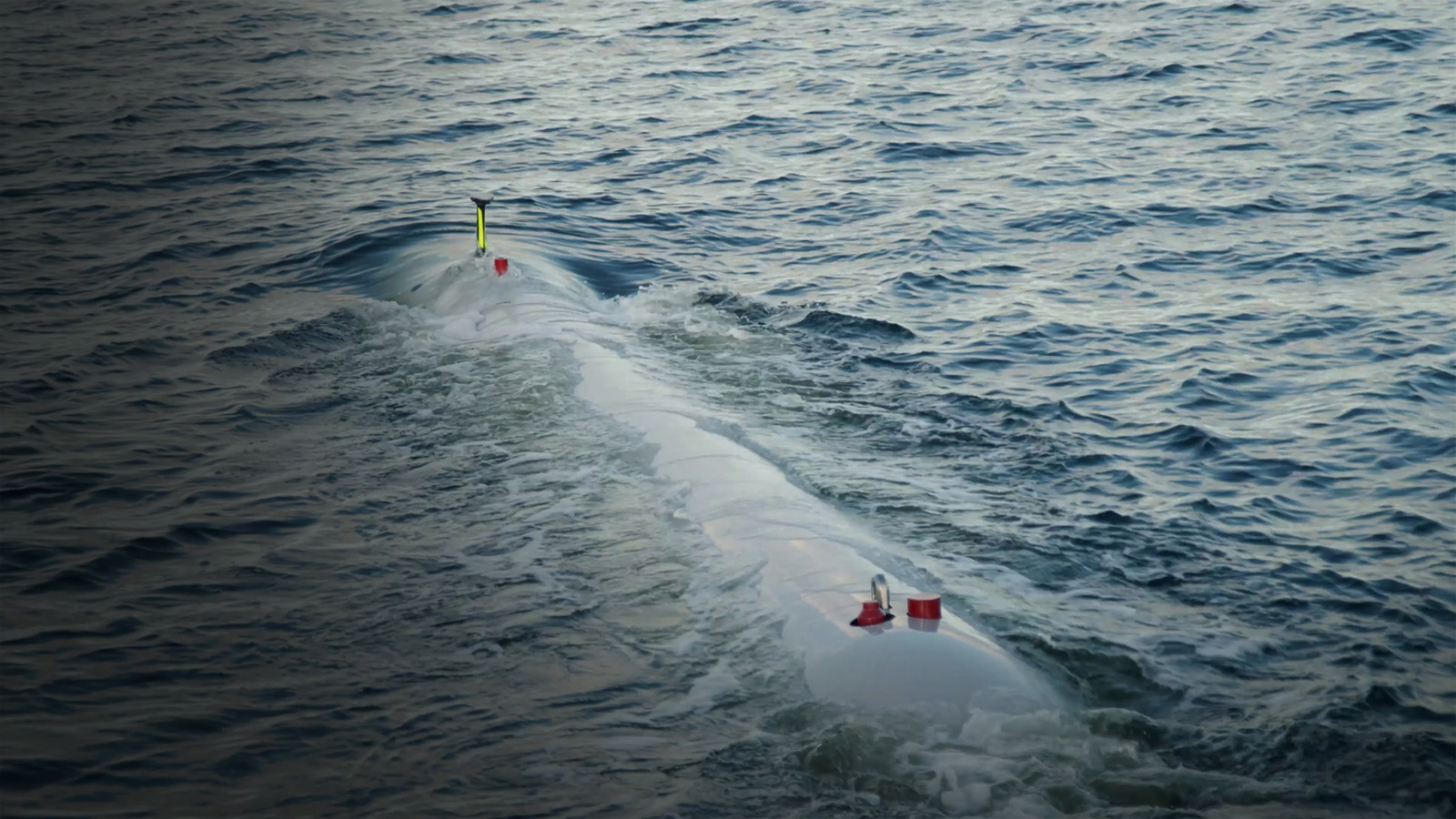
The latest addition to the HUGIN family, HUGIN Edge, brings these capabilities to a medium-class AUV designed for flexible deployment from crewed or uncrewed vessels, either independently or as part of a containerised system.
At the centre of HUGIN Edge is the HISAS 2020 synthetic aperture sonar, providing high-resolution imagery combined with a high area coverage rate. The vehicle can also process information while it is still operating underwater.
This can significantly change the way a mine-hunting mission is conducted.
From detection to decision
Finding a mine-like object is only part of the challenge. Operators also need sufficient information to determine whether the object represents an actual threat.
HUGIN systems have been able to automatically recognise mine-like objects since 2013. When communications are available, their location and classification can be transmitted to a vessel.
However, positive identification may require a second, closer inspection. Traditionally, that can mean recovering the AUV, programming another mission and deploying it again to capture imagery of the suspected object.
HUGIN Edge is designed to perform this process within a single sortie. It can detect and classify potential targets before conducting the closer inspection required to provide operators with the information they need to make a decision.
For Patterson, the operational advantage is straightforward:
“That's just about the most important thing in modern MCM. How fast can I clear a Q-route to get my ships out of the harbor and have high confidence that I did clear it? That's part of the new capability.”
Reducing the time between detection, identification and decision can be critical when access to a harbour, shipping lane or operational area needs to be established quickly.
Building a clearer picture of the seabed
Mine countermeasures are only one part of the challenge.
Critical infrastructure, including subsea communication cables, pipelines and energy installations, has made the seabed an increasingly important part of the security landscape. Understanding what is there, identifying changes and detecting potential threats requires persistent and highly accurate seabed intelligence.
HUGIN Superior is optimised for this type of seabed intelligence, surveillance and reconnaissance (ISR). Its navigation and positioning capabilities can be combined with a range of sensors, including KONGSBERG's HISAS synthetic aperture sonars and EM multibeam echo sounders.
The result is detailed information that can help operators understand both the seabed itself and activity within the surrounding environment.
HUGIN Endurance takes the same concept significantly further.
Designed for missions lasting weeks without support, the long-range AUV can operate from shore to shore, removing the need for a nearby support vessel and enabling discreet seabed ISR across large areas.
Its autonomous capabilities allow the vehicle to adapt to changing environmental conditions or sensor failures during a mission, while redundant systems help increase the probability that a mission can be completed successfully.
Detecting what has changed
For persistent seabed surveillance, collecting an accurate picture once is not enough. What may matter most is understanding what has changed since the last mission.
Change-detection technology being developed by KONGSBERG will allow HUGIN vehicles to retain previously collected seabed data and compare it with information gathered during subsequent missions.
Rather than requiring all collected data to be analysed only after recovery, the AUV will increasingly be able to identify anomalies while still conducting its mission.
This capability could help operators focus their attention on relevant changes across large areas of seabed, supporting missions ranging from infrastructure monitoring to seabed ISR.
Proven capability, available today
Autonomy is advancing quickly, and new underwater platforms continue to enter the defence market. But for navies considering how to close capability gaps, technological maturity and operational experience remain important considerations.
KONGSBERG has developed HUGIN AUVs for more than 30 years. HUGIN variants are already deployed with the U.S. Navy, eight NATO navies and Australia, supporting demanding military operations.
Patterson believes that maturity matters when capability is needed quickly:
“If you choose capability that you already know works, you can fill gaps much faster.”
As navies adapt to a more complex undersea environment, the question is increasingly not whether autonomous systems have a role to play, but how quickly proven autonomous capabilities can be integrated into existing operations.