Supporting sustainable success
With a world-class research vessel ‘ready to roll’ Angola is perfectly positioned to unlock understanding, value and informed developments in its ocean space. Jennifer Johnson of WHOI explains how, together with a group of Angolan fishery researchers and Kongsberg Discovery, she’s been helping build solid foundations for ongoing success.
-
Text:Kongsberg Discovery
Jennifer Johnson is beaming.
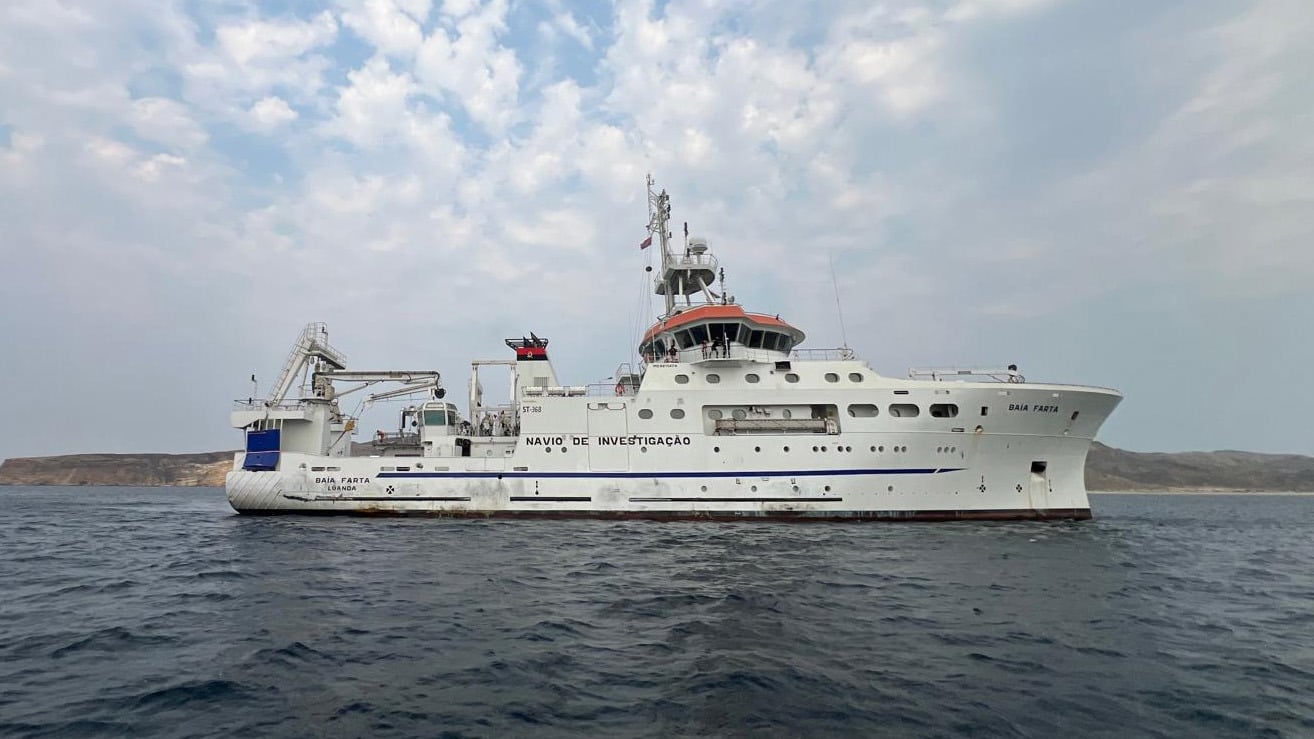
The Woods Hole Oceanographic Institution (WHOI) acoustics researcher is recalling the completion of a successful series of system calibrations with an acoustic team from the Instituto Nacional de Investigação Pesqueira (INIP) onboard the Baía Farta, an advanced research vessel owned and operated by the Angolan Ministry of Fisheries.
“I’m not sure I’ve ever had a day like it,” Johnson explains.
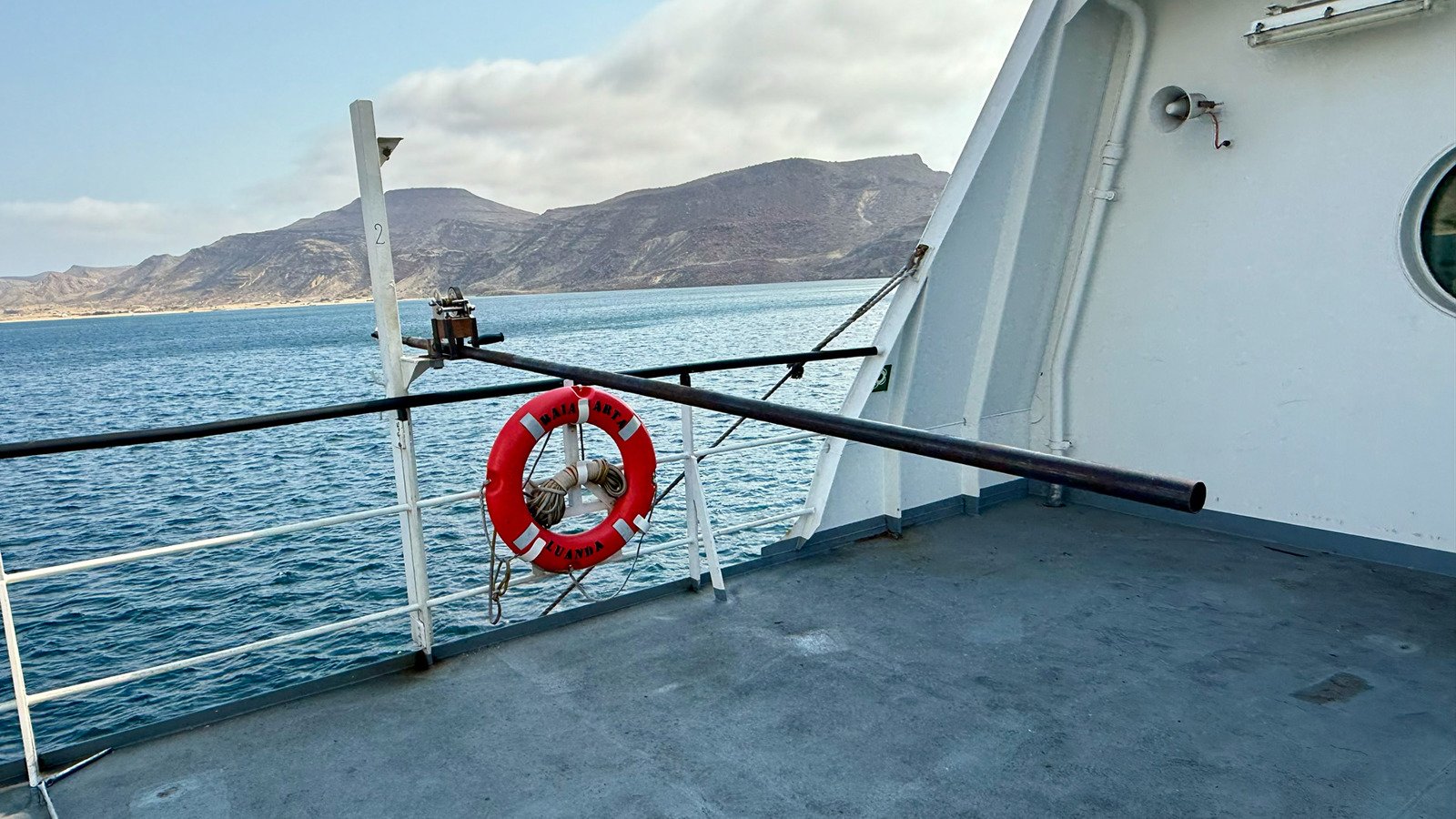
“We’d carried out calibrations for the first time for multiple systems in just under a week in Elefantes Bay, south of Benguela in Angola. We’d had challenging current and water conditions, we had to engineer our own telescopic outrigger system on board, we were undertaking training of the vessel and scientific crew at the same time – it was not a straightforward process, at all.”

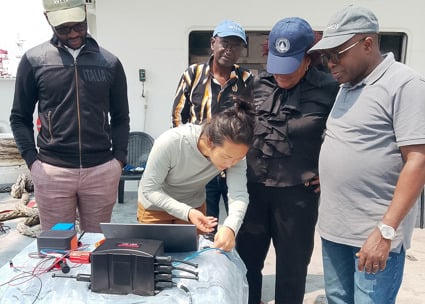
Aristóteles Amaro during EK80 calibration.
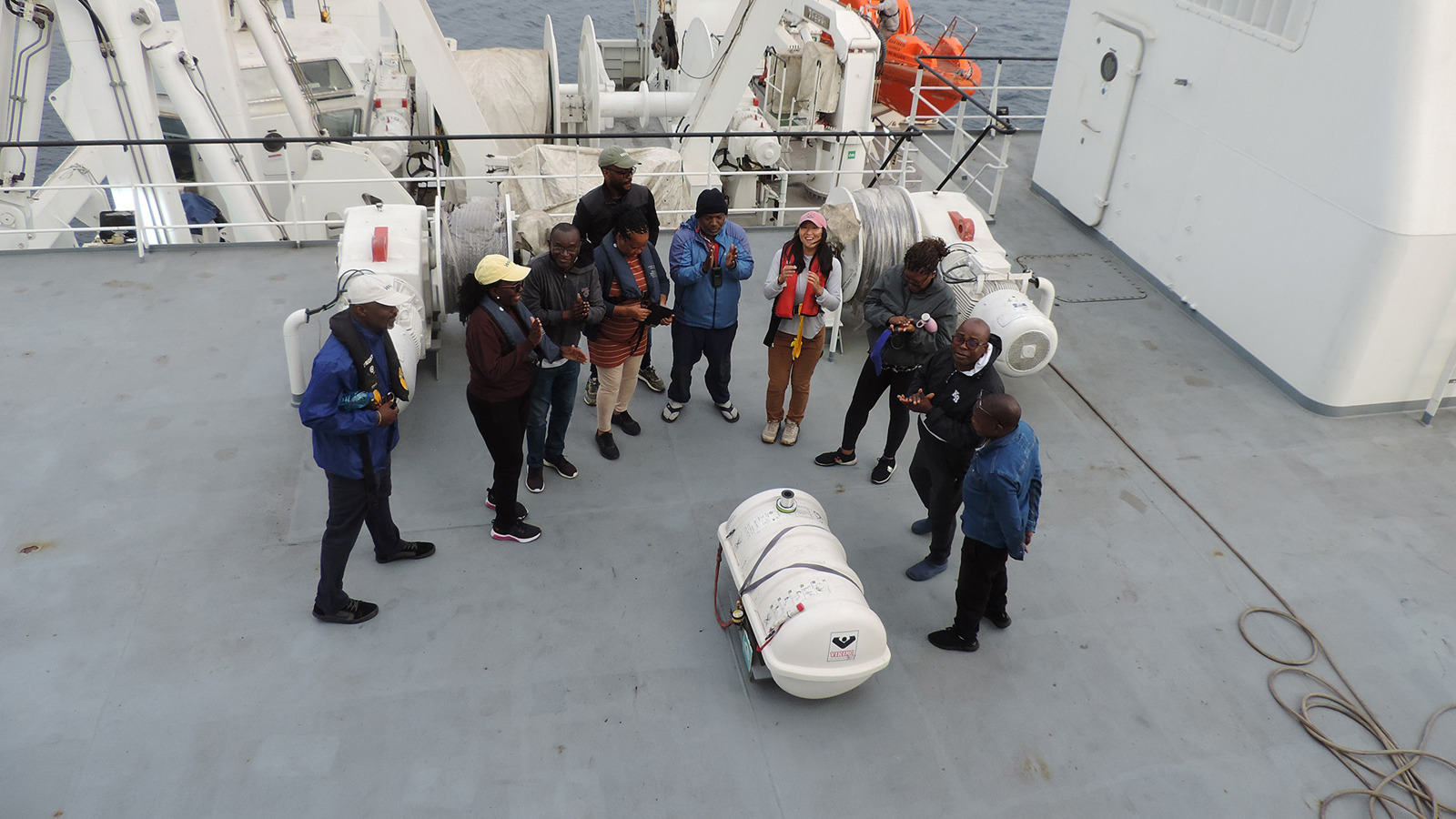
She continues: “But the team worked together wonderfully, overcoming the communication and operational challenges, and did a great job. Next thing I know, there’s music on deck and everybody’s dancing Kizomba, a local dance, to celebrate. There was so much joy, so much pride. Angola is still a young nation, and this vessel will undertake essential tasks, so it was fantastic to see how much it meant to everyone to make real progress.”
Johnson smiles, momentarily back on the deck where she spent several weeks last Fall as part of a WHOI, Kongsberg Discovery-supported, and Fulbright Program-funded mission: “It was so fulfilling to see the impact we could have. It’s an experience I’ll never forget.”

R/V Baía Farta in Elefantes Bay.

R/V Baía Farta port calibration outrigger station with telescoping poles in Elefantes Bay.
Empowering understanding
Johnson, who has been with WHOI for the past six years, was hosted by INIP’s director Dr. Filomena Vaz Velho and tasked with one of the lead roles in the training and calibration mission - helping build local capacity for running independent fisheries surveys and biomass monitoring programmes.
A spokesperson from the INIP team explained the need for the latest initiative: “The vessel was officially delivered to the Government of Angola in July 2019 and since then no acoustic surveys have been carried out due to limited capacity for operating and calibrating Kongsberg Discovery’s sounders, namely the EK80 and ME70 multibeam.”
The equipment on board the Baía Farta, including the EK80 echo sounder – the gold standard for fisheries biomass assessments – and the ME70 multibeam, enabling unique insights of school shape and size analysis, is crucial to national ambitions. It was Johnson’s role to ensure the payload was not just ready to perform, after several years of ramping up and platform refinement, but also to help Angolan scientists understand and exploit the huge potential of the solutions and applications.
Achieving that, she says, is critical to sustainable stewardship of both the environment and local communities.
“Angola is especially vulnerable,” Johnson states. “The combination of rapidly warming waters, oxygen depletion and illegal fishing has the potential to significantly decrease local fish stocks, and impact livelihoods. Monitoring and understanding the evolving situation is critical to making informed, more sustainable decisions, helping not just the ecosystems, but also the communities that rely on them. To achieve that you need a combination of optimal technology and expertise to get the best results. It was great to have Kongsberg Discovery’s partnership while onboard.”

Jennifer Johnson, Acoustics Researcher, WHOIThe experience of the sailors and scientists was amazing to see, they knew the waters, and the behaviours and dynamics of local fishermen, so well.
Transformational technology
Johnson worked closely with Dr. Scott Loranger in the US for the duration of her mission. Loranger, an Acoustician and Applications Scientist at Kongsberg Discovery, provided acoustic equipment for the task (including a portable WBT Mini, for training and demonstrations on and off vessel) and worked as a global hub for arranging domain-specific support for Johnson, when necessary.
“It was great to have Scott ‘on board’, knowing I could call on him to answer questions, provide documentation, and connect me within the Kongsberg network to solve issues,” she comments. “Getting the technology up and running again had unique challenges, but the robustness and quality of the sonars was apparent. I think we’re all looking forward to seeing the results that are produced in the years to come.”
Johnson believes the vessel can be a transformational asset for an ambitious country looking to accelerate development after a sustained period of conflict and change. With the solutions from Kongsberg at the fore, rapid steps forward can be made not just in stock management, conservation and ocean science, but also in charting, safe navigation and development.
“The experience of the sailors and researchers was amazing to see, they knew the waters, and the behaviours and dynamics of local fishermen, so well,” she comments. “However, Angola does not currently have comprehensive modern charts of all its coastline, and this is essential – not just for sailors, but also for infrastructure development, such as exporting minerals. The Baía Farta, equipped with technology such as its EM122 , for high-resolution seabed mapping, has a key role to play.
“I believe the potential for use by many different Angolan government departments is huge, as they continue to improve data collection methods and standards for management of their waters, coasts, and resources, so there’s a ripple effect of benefits that can be initiated now that it’s operational.”
From the perspective of the Angolan team, Dr. Velho states, “The presence of Jennifer provided an excellent opportunity to apply the ‘learning by doing’ principle. Thanks to this valuable experience, the operational and technical capabilities of our research vessel have now significantly improved, and Kongsberg Discovery’s collaboration was substantial for the success of this action.”
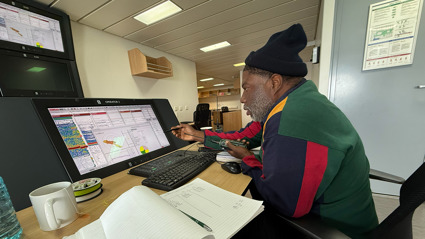
Primed for performance
Johnson’s passion for the project, and the people, is obvious.
She plans to continue collaborations with the researchers in Angola, and is committed to following the Baía Farta’s development, and impact, from afar.
“As a relatively newly independent nation, it’s so important to be able to conduct independent surveys and operations within ocean science and environmental management, rather than relying on external partners and resources,” she stresses.
“The vessel, technology and scientific team are primed to start that. They are rightly proud of this new capacity. And, on a personal basis, I’m definitely proud I was given the opportunity to contribute to such an important initiative.”
For further information about The Woods Hole Oceanographic Institution (WHOI) please see https://www.whoi.edu/