When Technology Works as One
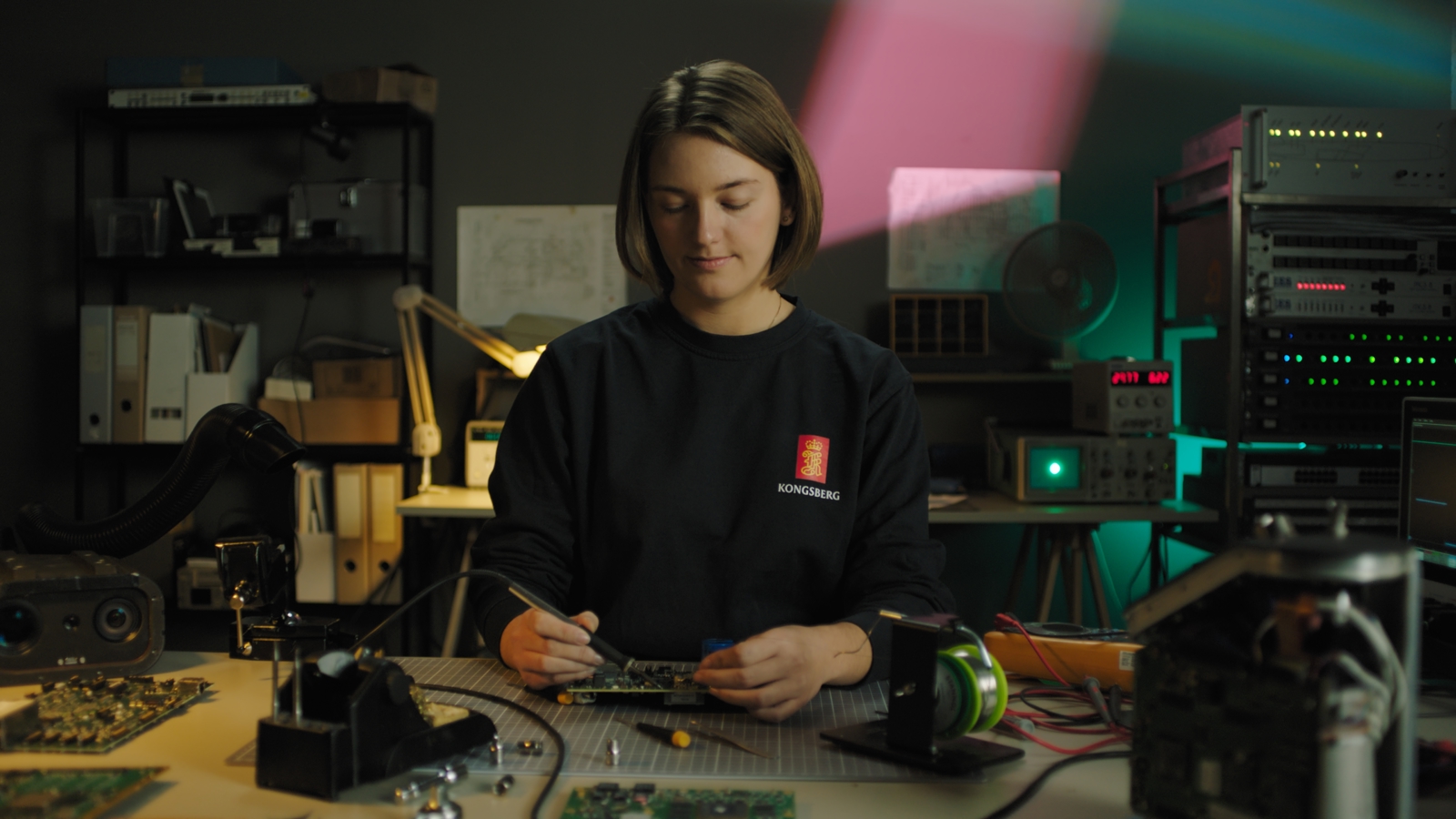
Behind robust missile systems lies a complex interplay of layers, signals, and details. Marte works with PCB layout, where every decision affects the product—and where technology has to work as one.
-
Text:Helene Bergset
Photo:Magnus Bjørnnes, KONGSBERG, Braden Jarvis
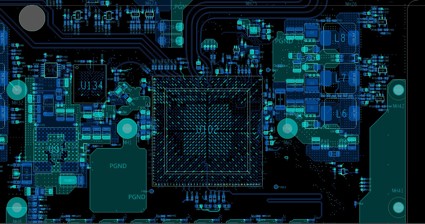
Much of Marte’s work involves placing components with attention to even the smallest details on a circuit board. Signal paths must have the correct length, timing, and impedance, and everything must function under extreme conditions.
“There are many technical challenges, but that’s also what makes the job so exciting,” she says.
Today, she works with PCB layout—more specifically, optimizing and designing circuit boards before they are sent to production.
A Childhood Shaped by a Strong Technology Environment
Marte’s interest in technology began early in life. She describes growing up in Kongsberg as being strongly influenced by its heavy technology environment.
“In school, many of my classmates had engineer parents, and we did lots of fun activities like coding with robots, LEGO League, and soapbox car racing,” she explains.
“Some of the fathers eventually built soapbox cars that were so fast they actually had to stop competing,” she laughs. “It was great fun, and that’s probably when my interest in technology really began.”
Still, it took time for her to fully understand what it truly meant to be an engineer.
“No one managed to explain in simple terms what an engineer does. Eventually, I learned that engineers make things. They develop and invent solutions. I’ve always found that incredibly fascinating,” she says.

Marte designs circuit boards in 3D, placing components and ensuring proper signal flow, ventilation, and power supply.
From Film Inspiration to Studies in Electronics
Her decision to study electronics came somewhat by chance. The inspiration came after she watched The Prestige (2006), a film in which the inventor Nikola Tesla appears in a supporting role.
“In the film, Tesla is portrayed as a slightly mad scientist who invents the light bulb. I found that incredibly cool, because electricity felt almost magical to me. You couldn’t see it working, yet with the flip of a switch, the light suddenly came on. I found that fascinating,” she says.
Her path led her to a bachelor’s degree in electronics and IT at OsloMet, specializing in medical technology such as hearing aids and robotic arms. To her, the transition to missile technology felt completely natural.

The technology is very transferable. We’re still developing electronics, and the components are the same—resistors and capacitors—just used in slightly different ways.
Back to Her Hometown
After several years in Oslo, she moved back to Kongsberg.
“As a student, Oslo is a fantastic city. Everything is so accessible, and there’s always something going on. But once I started working and had to fit everything into the hours after 4 p.m., I felt like I spent an incredible amount of time waiting in lines—at the store, in traffic, everywhere,” she says.
After the workday was over, there was little time left for the activities she actually wanted to do.
“I couldn’t make it all add up. When I moved back to Kongsberg, I felt like I had more time for the things I wanted to do,” she continues.
Advanced Protection of Circuit Boards
As a new employee at KONGSBERG, her first project involved a special surface treatment for circuit boards called parylene. The coating is applied in a vacuum and protects the electronics in demanding environments.
“It’s a pretty advanced coating that not many people use. At one presentation, they said they could even play a Nintendo Switch underwater because the electronics were coated that way,” she says.
In the project, she worked on qualifying the circuit boards and testing their ability to withstand the required stress. At the same time, she gained insight into how different professional disciplines collaborate across the organization—an experience she says gave her a valuable understanding of how the company is structured.
From the Lab to the Field
After completing the parylene project, she went on to help develop electronics for a product to be delivered to a customer. Field testing took place in several locations, including Hawaii.
“That was a turning point for me,” she says.
The contrast to laboratory work was significant.
“In the lab, we wear coats, use ESD protection, and aren’t allowed to bring food inside. In the field, people are wearing boots, stepping on signs that say ‘do not step here,’ while eating and testing equipment. It gives a different perspective on what the products actually have to withstand,” she explains.
The team traveled for five weeks and worked closely together to make the technology function.
“Because it was a development project, it was expected that things wouldn’t always work. But that also meant we engineers had to be there to solve the problems,” she says.
The experience made her more aware of how products are used in real life.
“When you sit in the office, it’s easy to forget the bigger picture. The systems we develop have to function in stressful situations, and that’s something we have to take into account when we design the product,” she says.
Designing Electronics in 3D
Marte describes electronics development as having two phases: creating the schematic and doing the PCB layout. Today, she mainly works with layout, which involves physically placing components on a circuit board according to the schematic.
“I design the board in 3D, placing the components and ensuring proper spacing, ventilation, signal routing, and power distribution,” she explains.
The board she is currently working on will be installed in a missile and consists of multiple layers—twice as many as in her previous projects. She describes it as advanced technology with many technical challenges, which she finds very enjoyable to work with.
“You can think of it like floors in a building. The electronic functions are on the top and bottom, and to get all the signals where they need to go, you have many layers that you drill down into and route the signal up or down to another component elsewhere,” she explains.
To save space, technologies such as microvias are used, where small connections between specific layers are laser-drilled instead of drilling through all layers.
High-Speed Technology
What makes the job technically demanding is, among other things, how fast components have become.
“When signals move very quickly, you have to match lengths and timing of signal paths with absolute precision. There’s also a lot of work with impedances and other details I didn’t know much about before I started working here,” she says.
At the same time, technology is often pushed to the limits of what suppliers can deliver.
“That requires tough prioritization. One of the challenges is being able to prioritize the right things and accept that something is ‘good enough,’ even though you naturally want everything you make to be the best,” she explains.
Learning the Most from Colleagues
Although her education provided a solid foundation, she believes that much of the real learning happens on the job.
“My studies gave me something to hang my knowledge on, but I’ve learned far more here,” she says.
A key part of that learning is the professional environment.
“We have many people who are experts in very specific areas. When you talk to them, it can feel like you don’t know anything—but then you just have to ask all the stupid questions as quickly as possible,” she says with a laugh.
Marte particularly highlights the collaboration within the department.
“Even though we all have a lot to do, people always take the time to help each other. We’re specialized in different areas, so we’re completely dependent on one another,” she explains.
The most experienced engineers often act as technical leads and contribute system-level understanding.
“They’re good at seeing the big picture and how all the parts fit together,” she adds.
Room for Both Nerdiness and Diversity
When asked what she values most about her colleagues, her answer is simple: diversity.
“You might think electronics engineers as a certain type of person, but here it’s very varied. Some like to sit quietly and work in deep concentration, while others go for an extra cup of coffee,” she says. “What we probably all have in common is that we’re quite nerdy—but beyond that, there’s a wide range of personalities and interests.”
What she personally appreciates most about her job is the technical challenges and the opportunity to continue developing.

We work with advanced technology. You never run out of technical challenges, and that’s why people stay here year after year.
Right now, she’s particularly looking forward to seeing the results of the project she’s working on.
“The circuit board I’m designing now will be finished in a few months, and then we expect it to be produced and delivered later this year. I’m really looking forward to seeing how it turns out. It’s a bit like designing something at IKEA and then seeing that it looks exactly the way you imagined it would at home,” she explains.
That’s also one of the reasons she still enjoys her job so much.
“I’ve been fortunate to work with what I want to do. Whenever I’ve said I want to learn more about something or work in a particular area, I’ve been given the opportunity. That’s very motivating,” she says. “That’s why I see no reason to do anything else,” she concludes.