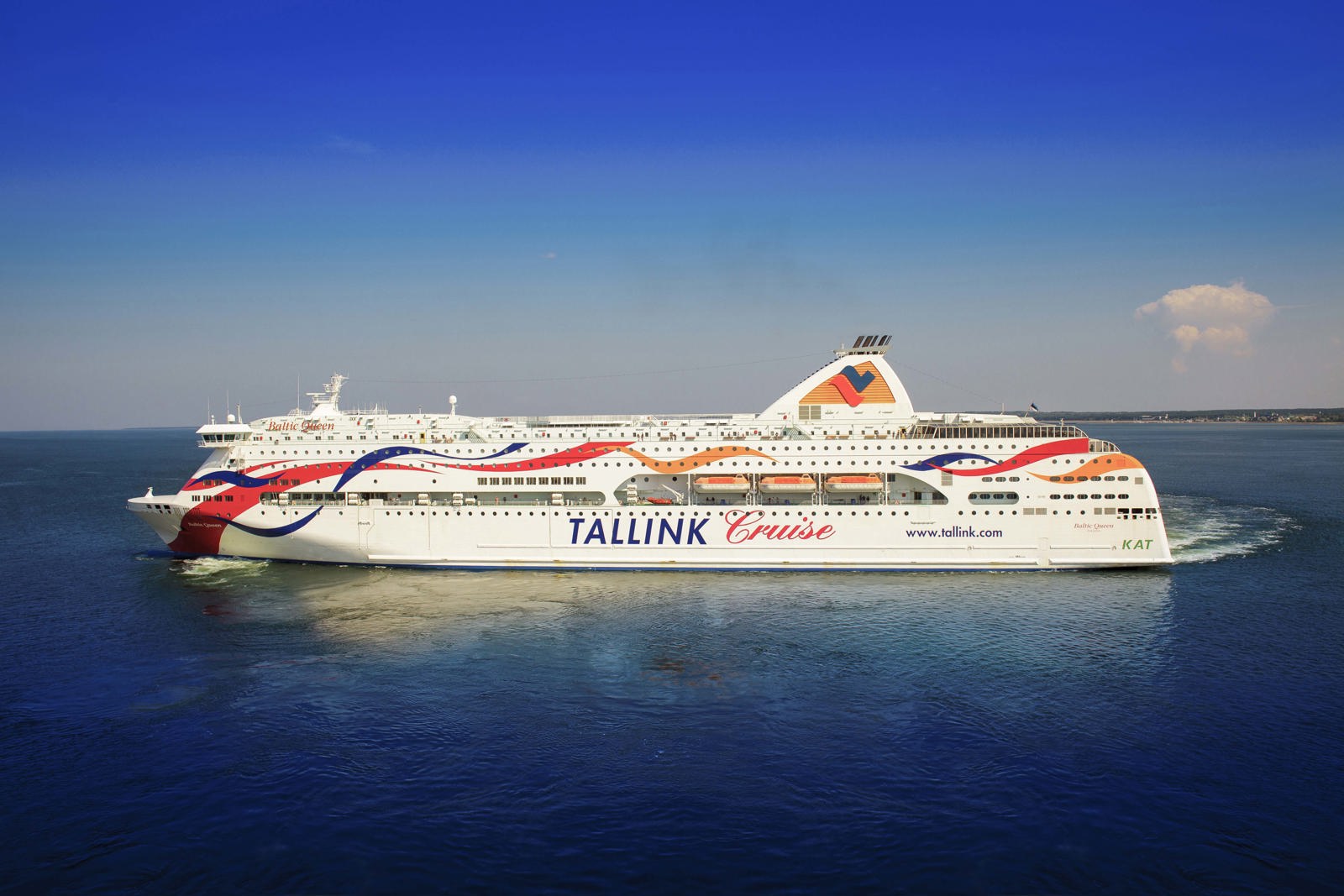
The upgrade of Baltic Queen has delivered many game-changing improvements. New propellers use less fuel, are better for the planet and have reduced noise levels.
When Tallink Group decided to upgrade the propellers on its cruise vessel, Baltic Queen, the goal was clear: cut fuel consumption, reduce emissions and improve environmental performance without compromising its schedule. Today, that decision is paying off as fuel and emissions are down, together with an added bonus of reduced underwater noise, all thanks to the new propeller profile.
Operating the busy route between Stockholm and Tallinn, with a stop at the Åland islands, the Baltic Queen is more than a ferry, it’s a vital link between nations. At 212 metres and carrying up to 2,800 passengers, the vessel runs a tight overnight schedule at speeds of 17 to 18 knots.
The new propeller system has improved efficiency and reduced emissions
“We operate like a bridge between countries,” says Andrus Vaher, Tallink’s Fleet Environmental Compliance Officer. “Passengers can enjoy entertainment overnight and arrive fresh in the morning. It’s a popular choice for business and leisure travellers alike.”
Despite its efficiency, Baltic Queen’s operational profile required three main engines on certain legs to maintain schedule. With four engines powering twin shafts and Kongsberg Maritime controllable pitch propellers (CPP), the team saw potential to optimise performance. “We constantly search for possibilities to increase efficiency and reduce fuel consumption across our fleet,” he explains. “We believed there was a way to run on two engines throughout the trip.”
That’s where Kongsberg Maritime came in, and with hydrodynamics and naval architecture expertise, the intervention proved decisive. After feasibility studies and simulations, the solution was clear: re-blade the CPPs to improve propulsion efficiency.
Baltic Queen is now more energy-efficient during journeys
Andrus Vaher has been impressed by Kongsberg Maritime’s performance
“Timing was critical,” says Andrus, as the upgrade had to align with Baltic Queen’s dry dock in September 2023. “Looking back, everything was deployed in due time and that’s a good recipe for success,” he recalls. The project involved replacing propeller blades and conducting sea trials to validate performance. Andrus praises Kongsberg Maritime’s role: “All answers and solutions from the company were extremely helpful and everything worked just fine. The performance even exceeded what was promised – a pleasant surprise.”
The impact was immediate. Baltic Queen now completes its crossings using two main engines instead of three, thanks to optimised blade geometry. Fuel consumption dropped by an average of 13 per cent per trip, saving about 4.5 tonnes of fuel on each crossing. “Such a fuel reduction is huge for a ship like this,” says Andrus. “With each voyage consuming around 35 tonnes of fuel, the annual savings are substantial, both financially and environmentally.”
Verification was key. Tallink compared post-upgrade data against years of historic records on the same route. “Verification is very important for us to see if the ROI is as promised,” he notes. The results confirmed the projections, and then some.
The ship provides high- quality facilities for its passengers
Passengers can enjoy the Baltic Queen’s buffet
The ship’s cabins are the perfect place to relax and unwind
Fuel savings translate directly into lower greenhouse gas emissions, aligning with Tallink’s sustainability strategy. But the benefits didn’t stop there. In collaboration with Tallinn Technical University (TalTech), Tallink measured underwater radiated noise before and after the upgrade.
The measurement report concluded that: “Taking into account the whole calculated ship spectrum (20 - 20 000 Hz), the broadband source level of the ship was reduced by about 8 dB after the refit. For context, an 8 dB noise reduction is a significant and easily noticeable decrease in sound intensity, though not quite half the loudness which is perceived at 10 dB reduction.” This represents a considerable reduction in underwater noise, and a forward-thinking move as the International Maritime Organization (IMO) explores future noise regulations.
“We wanted to be forward-thinking,” Andrus says. “And we monitored a considerable reduction in underwater noise. The project has attracted interest from the international maritime community and now forms one of the data inputs for developing global guidelines.” Passenger comfort improved too. Baltic Queen’s Masters reported less vibration during manoeuvring, which has been a subjective but welcome bonus.
For Tallink, the upgrade reinforces its commitment to sustainability. The company published its first ESG CSR-aligned sustainability report in 2025, featuring Baltic Queen’s success story. “We constantly work with Kongsberg Maritime to see what gains we can get from different solutions,” Andrus says. Feasibility studies are under way for other vessels, though route-specific economics will dictate viability. He is crystal clear about Kongsberg Maritime’s contribution: “We highly appreciate the technical knowledge, such as the hydrodynamics and the understanding of naval architecture. We are not naval architects, so having that expertise was crucial. From concept to execution, the collaboration delivered beyond our expectations.”
Tallink operates one of the Baltic’s most extensive ferry networks, connecting Estonia, Finland and Sweden. Its vessels are more than transport – they’re cultural and economic lifelines. “We have achieved a strong position of providing the reliable services that our customers have become accustomed to appreciate,” he notes, demonstrating the importance of maintaining reliable schedules.
As sustainability pressures mount, from EU ETS compliance to IMO decarbonisation targets, projects such as Baltic Queen’s propeller upgrade set a clear direction for innovation in reducing emissions. “It’s been highly successful,” Andrus concludes. “And it shows what’s possible when you combine operational insight with world-class engineering.”