Safe and smart tug operations
From training pilots to validating ship designs, Kongsberg Maritime’s K-Sim advanced simulation technology is transforming modern tug operations.
-
Text:Global Marketing and Communication
Photo:@Kongsberg Maritime
-
Craig TaylorSenior Manager PR & Communications
Advanced simulation is transforming tug operations, delivering safer ship handling, optimised port development and more efficient training for tug masters and pilots.
Over the past decade, simulation has evolved from a training tool into a strategic enabler for the towage industry.
Today, tug simulators are not only used to teach advanced manoeuvres in a risk-free environment, but they are also helping to shape port infrastructure, validate tug designs and support operational planning for complex projects.
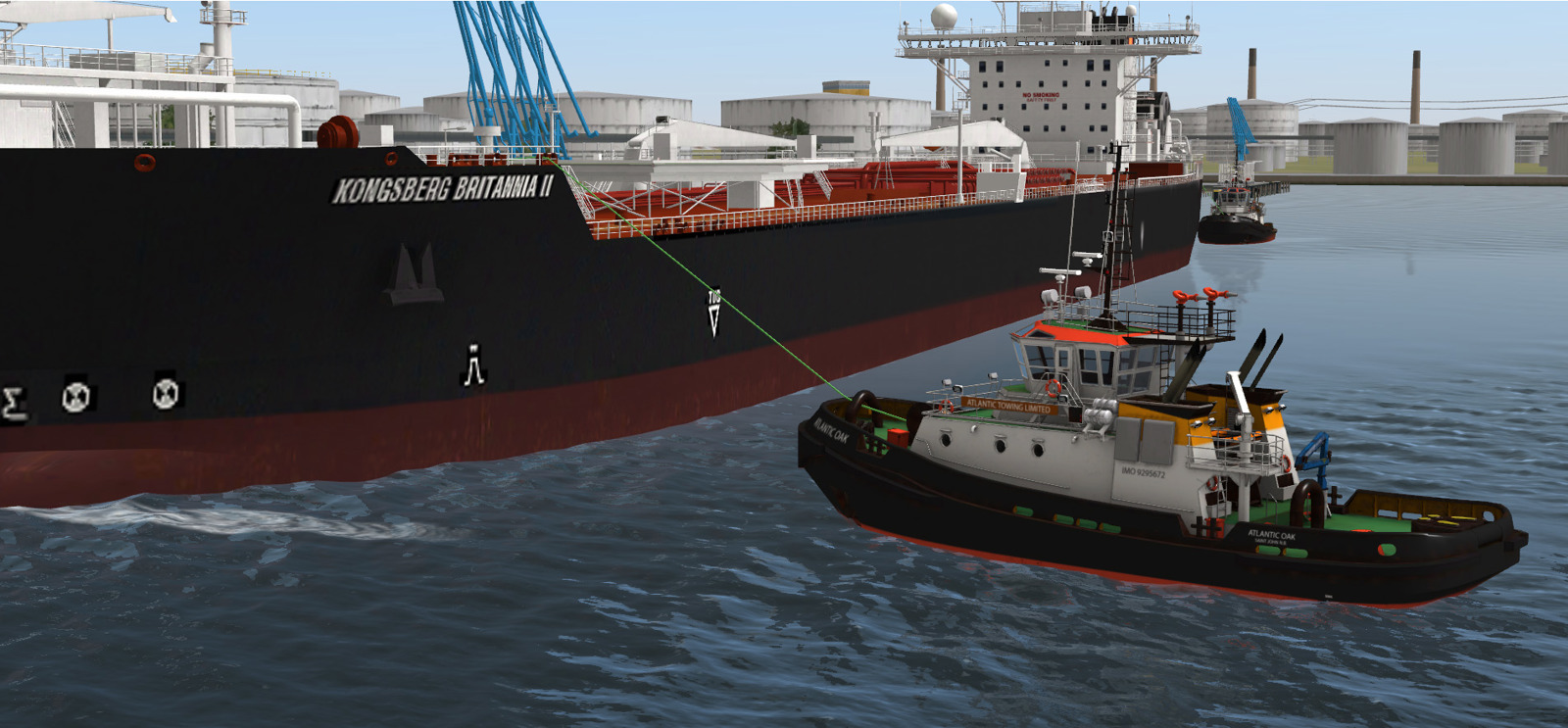
Modern tug operations involve high-risk tasks such as escorting LNG carriers at speed, docking ultra-large container ships and performing ship-to-ship transfers in challenging conditions. Simulation provides a safe, cost-effective way to test these scenarios before they happen in real life.
Garland Hardy, Consultant and tug simulation expert at Kongsberg Maritime, says: “General motion of tugs and their ability to maintain control are prone to exterior factors acting on them and affecting assisted ships. Simulating tugboats’ motions has become much better in the last 20 years due to developments in simulator platforms.”
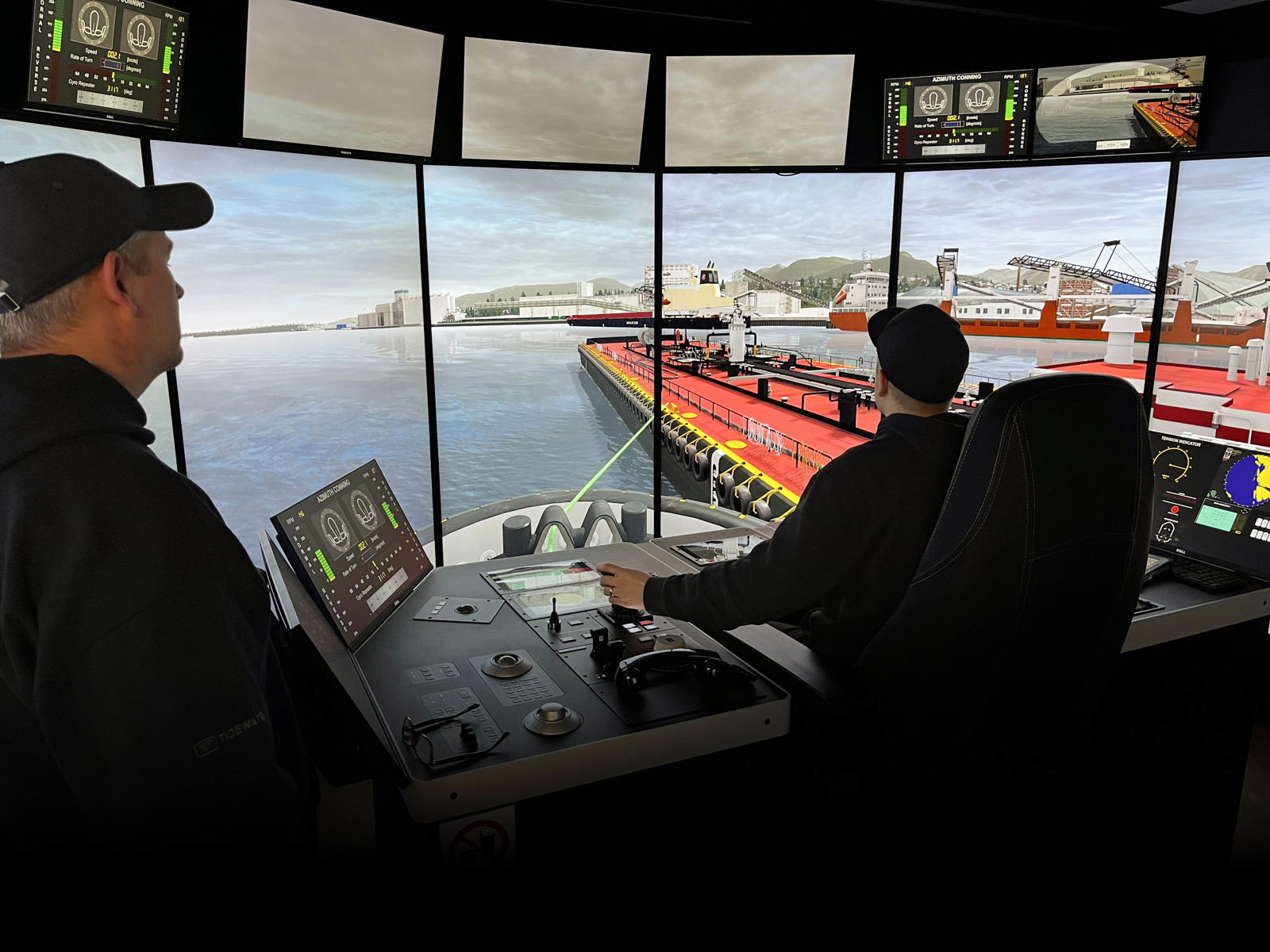
Kongsberg Maritime’s K-Sim advanced navigation simulator platform has hardware and instruments similar to those onboard a vessel. It delivers a visual scene that brings complete marine environments to life. That includes time of year and day, waves, currents, tides and their impact on tug and ship behaviours. The platform incorporates hydrodynamic manoeuvring models and algorithms that replicate real-world cause-and-effect, including forces on hulls, towlines and winches. This enables operators to explore performance limits and safety margins before committing to operations.
Simulation has played a critical role in major infrastructure projects. During the Panama Canal expansion, simulators were used to trial ship towage and escorting processes, ensuring safe navigation through new locks. More recently, Kongsberg Maritime supported LNG Canada and HaiSea Marine in planning escort and docking operations for gas carriers along a 200-nautical-mile route to Kitimat, British Columbia. These exercises evaluated winch performance, alternative routes and weather scenarios to prevent towline failures.

K-Sim replicates the tug’s physical wheelhouse
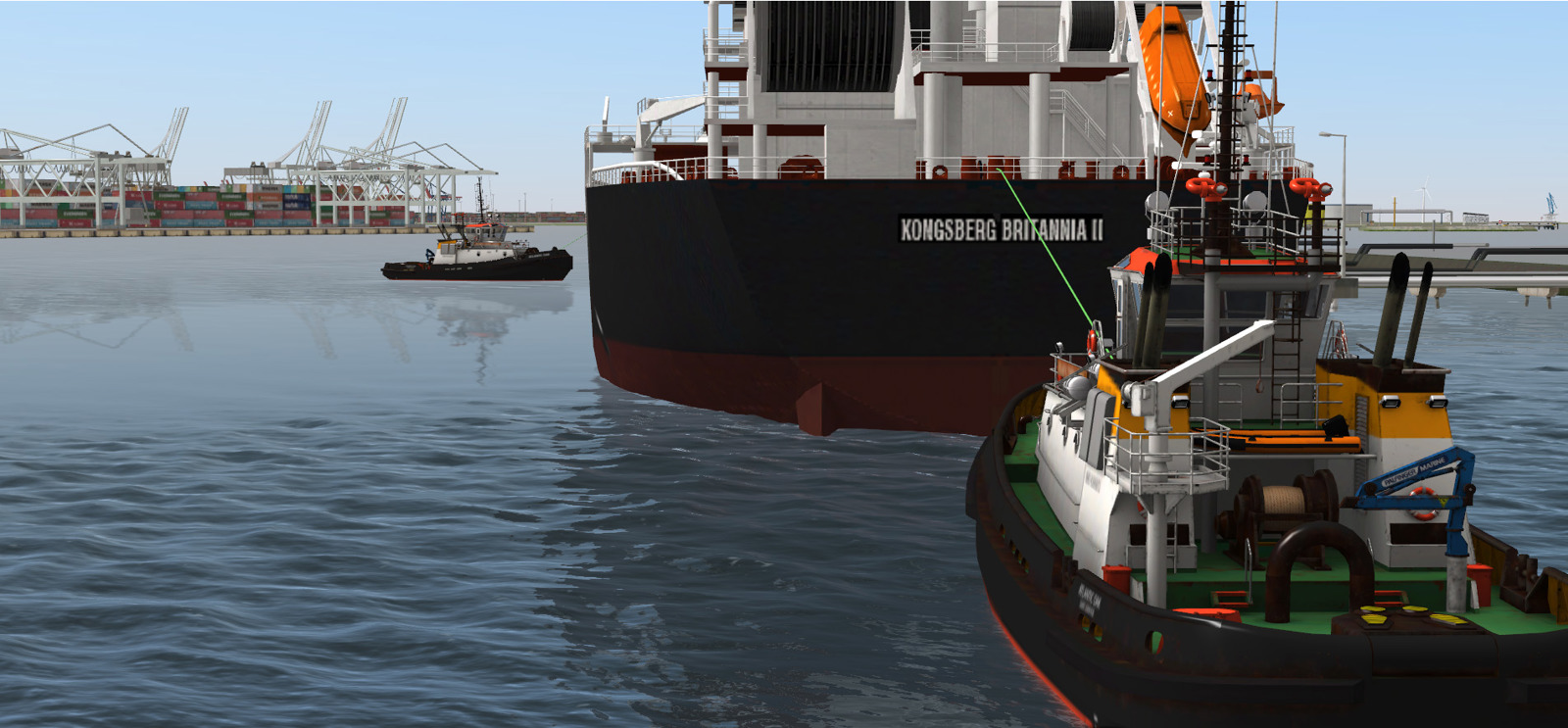
K-Sim allows operators to practice tug handling, such as escorting a large container vessel
Kongsberg Maritime simulators have also been deployed in Salina Cruz and Veracruz, Mexico, and in numerous United States ports to model container, tanker and bulk carrier operations. These projects demonstrate how simulation informs tug selection, power requirements and operational strategies.
Port authorities use simulation to model harbour layouts, predict tidal and current flows and assess how dredging may affect manoeuvrability. Seasonal runoff and tidal streams can dramatically alter water levels and current velocities, requiring different manoeuvring rules and risk factors. By modelling these conditions, operators can anticipate challenges and reduce operational risk.
Naval architects also rely on simulation to refine tug designs, adjusting hull forms and propulsion systems to meet specific operational needs. Some escort operations demand highly manoeuvrable tugs with unique hull shapes – requirements that can be validated virtually before steel is cut. For LNG carriers and container ships with pronounced flares, simulation helps determine the optimal tug configuration for safe and efficient handling
“We can simulate tugboat responses in various environments and in many ways, including their performance limits and the practical life cycle of winches,” Garland explains. “Simulation also considers different ship designs and how this changes towage and pushing operations. There could be different forces on ships and tugs, and all of this is incorporated into proof of concept and training programmes.”
Simulators are also used for mooring analysis and practising ship-to-ship transfers, replicating forces on tugs and towlines in various sea states. This capability is vital for offshore oil loading and other high-risk operations.
The latest evolution in tug simulation is the integration of augmented reality (AR) and virtual reality (VR). These technologies deliver immersive experiences while reducing hardware requirements, making advanced training more accessible. “VR is okay for visual cues, but operators need tactile feel of controls and to monitor real instruments,” Garland continues. Full-mission simulators replicate the tug wheelhouse, while AR offers a cost-effective alternative for smaller setups. “In years to come, AR will be incorporated in proof of concept and training simulators.”
This approach makes advanced training accessible and cost-effective.
Simulation is redefining safety and efficiency in tug operations by enabling risk-free training, supporting strategic planning, validating designs and making advanced training more accessible. As ports expand and ships grow larger, the ability to model and prepare for every variable will remain essential for safe and efficient towage.
This approach makes advanced training accessible and cost-effective.
Simulation is redefining safety and efficiency in tug operations by enabling risk-free training, supporting strategic planning, validating designs and making advanced training more accessible. As ports expand and ships grow larger, the ability to model and prepare for every variable will remain essential for safe and efficient towage.